There are various mechanical methods for producing powders for thermal spray: crushing, milling, attriting, and machining. While thermal spray powders have evolved principally from powder metallurgy procedures, the powder production technique has a marked influence on the nature of the powder that is produced.
The purpose of crushing is to break up large particles into a smaller-sized fraction by using mechanical energy. These processes are used mainly for ceramics because most metals would be plastically deformed, not broken up into smaller particles. High-purity stock can be made by melting the raw materials in an electric furnace.
Ceramics and some metals can be reduced in size by mechanical impact and deformation. Crushing processes employ equipment such as hammer mills, stamping mills, jaw crushers, and gyratory crushers. The coarse crushing stage is followed by milling, a more refined technique that enables control of the particle size.
Milling involves the disintegration of brittle, friable materials (some metals and most ceramics) or the pulverization of malleable metals. The particles so formed often have an irregular shape and are of variable particle size that may be less than 5 μm (0.2 mil). All of these powders are classified so that any fines can be post processed by agglomeration to form a suitable thermal spray powder. The technical term classification refers to sieving operations that separate powdered materials into specified size ranges. The size range is referred to as a cut of that particular material.
Milling machines include rod mills and ball mills. Care must be taken to ensure that the grinding medium does not overly contaminate the material that is being reduced in size. The milling medium is usually of high specific gravity. For example, alumina, steel, zirconia, and mullite are common, although cemented carbides are sometimes used where contamination must be kept to a minimum. The use of higher-density grinding media gives rise to a higher grinding rate, because the impact during tumbling is greater. The mill liners are generally vulcanized rubber, polyurethane, high-density alumina, porcelain, tungsten carbide (for laboratory mills), or stainless steel.
Rod mills grind large particles (greater than 15 μm, or 0.6 mil) more efficiently than ball mills. Ball mills grind all-sized particles to the same degree, and hence, a larger variability in size distribution occurs. Ball mills are filled to approximately 50% of the total volume with the grinding medium. The powder charge constitutes 25% of the total mill volume for dry ball milling and is generally 30 to 40% of the total volume for wet ball milling operations.
A small amount (approximately 1 wt%) of grinding aid, such as stearic acid (CH3(CH2)16CO2H) or folic acid (C19H19N7O6), is added to prevent the formation of aggregated lumps (also termed as caking) of the powder charge. In wet ball milling, the charge is suspended in an inert liquid such as alcohol, acetone, or water. High-viscosity suspensions usually give rise to low grinding rates, while the other extreme of low solids content increases the wear rate on the mill lining and grinding medium.
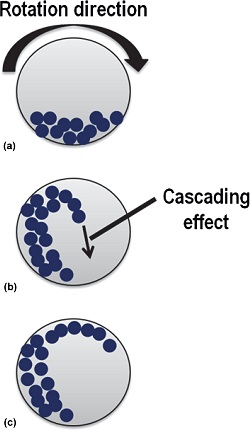
The speed of the rod or ball mill is quite critical with regard to the life of the equipment and the efficiency of the process. It is necessary for the balls (or rods) to drop from the top of the mill onto the material that is being ground. If the mill speed is too fast, then the medium will either not fall due to centrifugal forces or will fall directly onto the bottom of the mill and accelerate medium wear due to chipping. At low speeds, the medium does not drop at all, whereas at the optimum speed, the medium continuously cascades onto the material that is being crushed.
Image – Comminution variables that control particle grinding and efficiency at (a) low, (b) optimum, and (c) high speed. The balls or rods within the mill are indicated.
This information is from ASM Handbooks Online, Vol. 5A: Thermal Spray Technology, Coating Structures, Properties, and Materials. To find this information (subscription required), click on the link below and scroll down to Figure 1.
https://dl.asminternational.org/handbooks/edited-volume/12/chapter/133823/Feedstock-Material-Considerations-for-Thermal