 Electrolytic methods of forming metals that can be electrodeposited are versatile, and it is possible to produce powders of approximately 60 metals. The majority are obtained by molten-salt electrolysis, and powders of approximately 20 metals can be electrodeposited from aqueous solutions. While a larger number of metals can be obtained in powder form by way of molten-salt electrolysis, the larger quantities of powders are produced by electrolysis from aqueous solutions. Powders such as copper, iron, and nickel are obtained from aqueous solutions.
Electrodeposited metal powders are of high purity and therefore are extremely active during sintering. However, they demonstrate the following deficiencies: the process demands purification so that residual impurities could be removed, the electrolysis technique is often expensive, and the process is usually limited to the production of pure metal (i.e., nonalloyed) powders.
Electrolytic metal powder forms as a dendritic electrodeposit, which can spontaneously fall off or can be removed from the electrode by tapping or by other similar ways. The powder has a tendency to form flakes or needles, or be deposited in fibrous or spongy forms, depending on the electrodeposition process parameters and on the nature of the metal.
Electrolysis conditions that favor the diffusion process of electrodeposition enhance the formation of electrolytic metal powder. For example, a decrease of metal salt concentration, an increase in concentration of an electrolyte, a decrease of stirring rate, an increase of current density, a decrease of temperature, and an increase of the solution viscosity are factors favoring powder formation. In addition to these factors, the deposit structure depends on the nature of the metal and the salt species used in the electrolyte solution.
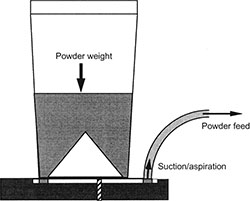
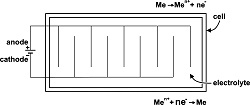
The scheme of an electrolytic cell for electrodeposition of metal powder is shown in the image. It is similar to a cell that is used for electroplating. The cell must have a slanting bottom so that the powder can be guided to a collection place for removal.
Image – Electrolytic cell for the deposition of metal powder.
This information is from ASM Handbooks Online, Vol. 5A: Thermal Spray Technology, Coating Structures, Properties, and Materials. To find this information (subscription required), click on the link below and scroll down to Figure 4.