When a spacecraft reenters Earth’s atmosphere at hypersonic velocities, its protective heat shield faces the most extreme conditions, including temperatures beyond 3,000 degrees Fahrenheit. To survive, the shield relies on specialized materials that absorb the heat as it degrades away in a controlled process called ablation, sacrificing the outer layers of the heat shield to protect the vehicle and crew within.
Designing those materials requires understanding exactly how they degrade — but watching that process at the microscopic level, in enough detail to capture necessary information on the materials, has been a challenge, forcing engineers to rely on pre- and post-test observations to develop computational models.
At the Advanced Light Source (ALS) at the Department of Energy’s Lawrence Berkeley National Laboratory (Berkeley Lab), researchers found a way to watch ablation in real time.
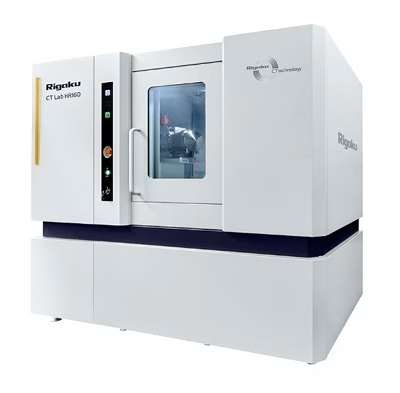
Using a sample environment on an X-ray tomography instrument that independently controls temperature, pressure, and gas mixture, recreating realistic, evolving reentry conditions. Findings from a recent study carried out in part at the ALS offer detailed, time-lapse, 3D images of this process, improving how engineers model and design thermal protection systems for space missions, including NASA’s recent Artemis missions.
As part of a long-term collaboration with the ALS, a team of researchers from the University of Illinois Urbana-Champaign and NASA used in situ X-ray micro-computed tomography, known as micro-CT, to peer inside a class of heat shield materials called superlight ablators, the same kind used on the backshells of NASA spacecraft. The team pushed the technique further than ever before by heating the samples to 1,652 degrees Fahrenheit, the top of temperature range in which the materials begin to decompose, and imaged them on the micrometer scale over multiple time points.
The researchers studied two commercial ablators, SLA-220 and SLA-561V, which are used in different parts of spacecraft backshells and are made with different compositions. Through the micro-CT technique, researchers tracked how high-temperature heating similar to atmospheric reentry affects the real-time multiphase chemical decomposition and porosity.
These measurements provide data for developing and validating predictive models, reducing uncertainty in heat shield performance, improving mission planning and ultimately helping ensure the safety and reliability of future crewed exploration missions.
To observe the ablators evolving, the scientists had to balance an experimental trade-off between rapidly collecting images of large, representative areas at lower resolution and capturing structural details at high resolution. To capture large sample areas quickly while preserving fine microscopic details, the researchers deployed an AI-based super-resolution method driven by generative adversarial networks.
The high-intensity broad spectrum flux from the light source allowed the team to quickly snap large-volume, lower-resolution scans at short intervals to track fast-moving structural changes. Meanwhile, switching to a single-wavelength beam enabled them to capture crisp, high-resolution snapshots of the static samples before and after the heating process.
The AI-enhanced imaging revealed a striking difference between the two heat shield materials. SLA-561V contains cork — the same natural material used in wine bottle stoppers — as a structural filler. When heated, the cork chemically breaks down and disappears, leaving behind open, empty pockets distributed throughout the material. SLA-220 contains no such organic filler; instead, its rubber-like silicone matrix responds to heat by forming a dense, branching network of interconnected channels.
These are not just visual differences. Open, isolated pockets behave differently from an interconnected channel network when heat and gas move through a material at reentry conditions, and those differences affect how each material performs as a heat shield.
The findings give engineers something they have not had before: direct measurements of how heat shield materials change at a microscopic level during the thermal conditions of atmospheric reentry that bolster past observational studies, improving model development and allow missions to return safely home.
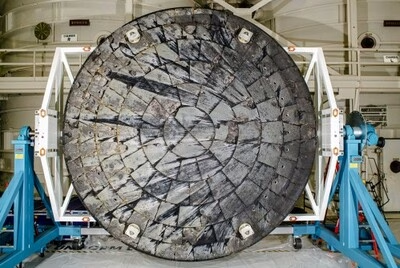
Image – A heat shield removed from NASA’s Orion spacecraft and inspected following the Artemis flight. Courtesy of: NASA.
For more information:
Lawrence Berkeley National Laboratory
https://www.lbl.gov/