Scientists in Japan have uncovered unusual quantum behavior in “heavy” electrons within the crystalline compound CeRhSn, which could one day support advances in quantum computing. These electrons appear to carry hundreds of times their normal mass—not due to their intrinsic properties, but because of strong interactions with other particles in the material that slow them down. Unlike typical metals, the electrons in CeRhSn enter a “non-Fermi liquid” state, moving collectively and entangled rather than individually. Remarkably, this state follows a universal energy dissipation rule known as Planckian scaling, linking the behavior to fundamental constants of nature.
n ordinary conductors like copper, electrons scatter in a way that can be calculated with standard physics. But at the edge of magnetism, superconductivity, or other collective phases, those rules break down. According to the researchers, CeRhSn sits right at this edge, making it a prime example of what physicists call “quantum criticality.”
The significance, according to the team, is that quantum critical materials may offer new routes for building quantum technologies. While most current quantum computers use superconducting circuits or trapped ions, heavy-electron compounds could provide an alternative platform where information is stored in the collective motion of electrons.
Dr. Shin-ichi Kimura of The University of Osaka, who led the research, said, “Our findings demonstrate that heavy fermions in this quantum critical state are indeed entangled, and this entanglement is controlled by the Planckian time. This direct observation is a significant step towards understanding the complex interplay between quantum entanglement and heavy fermion behavior.”
To probe CeRhSn, the team grew single crystals of the material in a controlled furnace and then polished them for study. They shined polarized light along different crystal directions and recorded how the electrons responded across a wide range of energies.
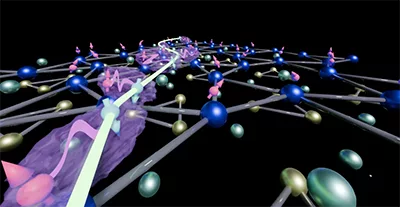
The experiments showed a distinct directional difference. In the plane where the cerium atoms form a kagome-like pattern—a triangular lattice with inherent frustration—the electrons followed Planckian scaling below about 80 Kelvin, or -193°C. Along the vertical axis, however, the electrons did not follow the same rule. The researchers interpret this anisotropy, or direction dependence, as evidence that the geometry of the lattice strongly shapes how the electrons behave.
While the findings demonstrate that heavy electrons can follow universal scaling laws, they do not yet provide a recipe for building a quantum computer. According to the study, the scaling behavior appeared only along one direction in the crystal, underscoring the material’s complexity.
The researchers also note that different experimental probes sometimes yield conflicting results. For example, while optical conductivity measurements suggested Planckian behavior, other measurements such as heat capacity report different values. Reconciling these differences will require further experiments.
Quantum computing today is built on platforms that manipulate single quantum states and properly managing entanglement. Although there is work to do, the study points to a different possibility: harnessing the collective entanglement of many strongly interacting electrons. While speculative, the researchers argue that observing Planckian scaling in heavy-electron systems adds weight to this idea.
The researchers suggest that CeRhSn may represent a new class of quantum critical material, distinct from compounds where magnetism dominates. They propose studying other materials with similar lattice structures to see if the same directional scaling appears. Pressure, chemical substitution, or magnetic fields could also be used to test how far the Planckian regime extends.
If the phenomenon proves robust, scientists report they could eventually try to design materials where the collective state of heavy electrons can be stabilized and controlled. Such systems might support qubits that are less sensitive to noise than those in existing technologies.