Scientists at Oxford University have developed a groundbreaking approach to generating solar electricity without silicon-based panels. Their innovation involves coating a new, ultra-thin, and flexible light-absorbing material onto everyday objects like rucksacks, cars, and mobile phones. This material uses a multi-junction technique to stack multiple light-absorbing layers into one solar cell, capturing a broader spectrum of light and generating more power from the same amount of sunlight.
This new material has been independently certified to achieve over 27% energy efficiency, matching the performance of traditional silicon photovoltaics for the first time. The certification from Japan’s National Institute of Advanced Industrial Science and Technology (AIST) precedes the publication of the researchers’ study later this year.
“During just five years experimenting with our stacking or multi-junction approach, we have raised power conversion efficiency from around 6% to over 27%, close to the limits of what single-layer photovoltaics can achieve today,” said Dr Shuaifeng Hu, Post Doctoral Fellow at Oxford University Physics. “We believe that, over time, this approach could enable the photovoltaic devices to achieve far greater efficiencies, exceeding 45%.”
This compares with around 22% energy efficiency from solar panels today (meaning they convert around 22% of the energy in sunlight), but the versatility of the new ultra-thin and flexible material is also key. At just over one micron thick, it is almost 150 times thinner than a silicon wafer. Unlike existing photovoltaics, generally applied to silicon panels, this can be applied to almost any surface.
‘By using new materials that can be applied as a coating, we’ve shown we can replicate and out-perform silicon while also gaining flexibility. This is important because it promises more solar power without the need for so many silicon-based panels or specially built solar farms,’ said Dr Junke Wang, Marie Skłodowska Curie Actions Postdoc Fellow at Oxford University Physics.
The researchers believe their approach will continue to reduce solar costs and make it the most sustainable form of renewable energy. Since 2010, the global average cost of solar electricity has fallen by almost 90%, making it almost a third cheaper than that generated from fossil fuels. Innovations promise additional cost savings as new materials, like thin-film perovskite, reduce the need for silicon panels and purpose-built solar farms.
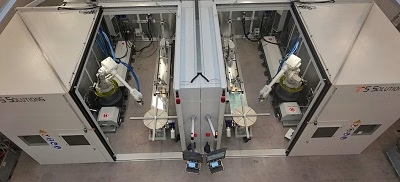
The researchers are among 40 scientists working on photovoltaics led by Professor of Renewable Energy Henry Snaith at Oxford University Physics Department. Their pioneering work in photovoltaics and especially the use of thin-film perovskite began around a decade ago and benefits from a bespoke, robotic laboratory.
Their work has strong commercial potential and has already started to feed through into applications across the utilities, construction, and car manufacturing industries.
For more information: University of Oxford
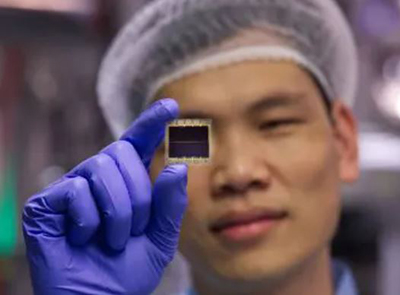
Image: Dr Shuaifeng Hu, Post Doctoral Fellow at Oxford University Physics, examining the new thin-film perovskite material. Image credit: Martin Small.