As climate change leads to hotter and drier conditions, fire seasons are becoming longer and wildfires more frequent and severe, devastating communities and economies. To address this growing threat, Stanford researchers have developed a water-enhancing gel that can be sprayed on homes and critical infrastructure to prevent them from burning during wildfires. This new gel lasts longer and is significantly more effective than existing commercial gels, providing extended protection even when applied well in advance of a fire, according to Eric Appel, associate professor of materials science and engineering.
Water-enhancing gels are made of super-absorbent polymers – similar to the absorbent powder found in disposable diapers. Mixed with water and sprayed on a building, they swell into a gelatinous substance that clings to the outside of the structure, creating a thick, wet shield. But the conditions near a wildfire are extremely dry – temperatures can be near 100 degrees, with high winds and zero percent humidity – and even water locked in a gel evaporates fairly quickly.
In the gel Appel and his colleagues designed, the water is just the first layer of protection. In addition to a cellulose-based polymer, the gel contains silica particles, which get left behind when the gels are subjected to heat.
“We have discovered a unique phenomenon where a soft, squishy hydrogel seamlessly transitions into a robust aerogel shield under heat, offering enhanced and long-lasting wildfire protection. This environmentally conscious breakthrough surpasses current commercial solutions, offering a superior and scalable defense against wildfires,” said the study’s lead author, Changxin “Lyla” Dong.
“When the water boils off, and all of the cellulose burns off, we’re left with the silica particles assembled into a foam,” Appel said. “That foam is highly insulative and ends up scattering all of the heat, completely protecting the substrate underneath it.”
The silica forms an aerogel – a solid, porous structure that is a particularly good insulator. Similar silica aerogels are used in space applications because they are extremely lightweight and can prevent most methods of heat transfer.
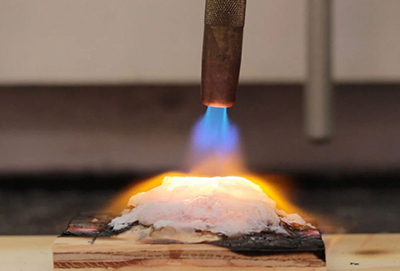
The researchers tested several formulations of their new gel by applying them to pieces of plywood and exposing them to direct flame from a gas hand torch, which burns at a considerably higher temperature than wildfire. Their most effective formulation lasted for more than 7 minutes before the board began to char. When they tested a commercially available water-enhancing gel in the same way, it protected the plywood for less than 90 seconds.
“Traditional gels don’t work once they dry out,” Appel said. “Our materials form this silica aerogel when exposed to fire that continues to protect the treated substrates after all the water has evaporated. These materials can be easily washed away once the fire is gone.”
The new gels build off of Appel’s previous wildfire prevention work. In 2019, Appel and his colleagues used these same gels as a vehicle to hold wildland fire retardants on vegetation for months at a time. The formulation was intended to help prevent ignition in wildfire-prone areas.
“We’ve been working with this platform for years now,” Appel said. “This new development was somewhat serendipitous – we were wondering how these gels would behave on their own, so we just smushed some on a piece of wood and exposed it to flames from a torch we had lying around the lab. What we observed was this super cool outcome where the gels puffed up into an aerogel foam.”
After that initial success, several years of additional engineering were needed to optimize the formulation. It is now stable in storage, easily sprayable with standard equipment, and adheres well to all kinds of surfaces. The gels are made of nontoxic components that have already been approved for use by the U.S. Forest Service, and the researchers conducted studies to show that they are easily broken down by soil microbes.
“They’re safe for both people and the environment,” Appel said. “There may need to be additional optimization, but my hope is that we can do pilot-scale application and evaluation of these gels so we can use them to help protect critical infrastructure when a fire comes through.”
For more information: Advanced Materials
Image: During a test on plywood, researchers showed how the new gel transitions from a hydrogel to an aerogel under heat from a gas hand torch. The torch burned at a much higher temperature than would result from a wildfire. Credit: Andrea d’Aquino