The specification of a material is important for the TS process. A thorough knowledge of the appropriate standards and testing procedures is necessary for appropriate comparisons between materials. These considerations should not be considered alone but in conjunction with the TS process, because this also influences the coating quality. Some of the quality-control tests that should be considered are powder manufacture, particle size, powder quality control, material chemistry, Heill flow rate, deposition parameter, safety, porosity of powder, and handling characteristics.
Any of the existing standards or potential standards for powder quality control should be implemented with regard to the intended use of the coating/substrate system. It is important that any coating not only be subject to some specific standard but that the standard be relevant to the particular feedstock material. The following aspects can be noted with regard to testing methods for feedstock materials.
There are two major methods of measuring the particle size (other than the sieving method): by an x-ray method or by a light-scattering technique. Batches of the same material, when tested by the two methods, have been found to produce quite different particle size distributions. There are technical reasons for this discrepancy, but, more to the point, it is disturbing that the particle size depends on the measuring technique, because the TS applicator desires these data to optimize the spray parameters. The upshot of this discussion is that the measuring technique for the mean particle size or the particle size distribution should always be referenced so that the applicator is able to adjust the spray parameters accordingly.
A quality-control issue that is related to powders concerns the examination of deposits. A simple method of determining whether the material or thermal spray parameters are suitable is the wiper blade test. This involves passing a series of glass sides (or metallic substrates) in front of the thermal spray torch during a trial powder-spraying operation. Usually, a series of glass slides are tested simultaneously by offsetting them on a rotor-type device so that a range of stand-off distances can be examined in one TS run. The degree of particle melting can be quickly determined by optical microscopy and the optimum TS deposition parameters found. The best powder/spraying conditions will be obtained when a well-formed and coherent splat can be produced.
It is appropriate to comment on the powder-feeding problem that was addressed earlier. Three common observations that infer a quality-control procedure is necessary are as follows:
- Powder has irregular flow. For example, it is observed that the powder seems to be turning on and off.
- The powder can only be fed at high carrier gas flow rates. These flow rates are high enough to carry the powder straight through the thermal source.
- The deposit efficiency is observed to be low.
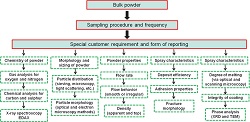
Possible solutions to these problems include adjusting the powder port and delivery tube sizes, drying the powder in an oven, and/or homogenizing the powder by rotating the powder container for a few minutes. Powder testing and the associated quality control must be an unending task, and a suggested schedule is shown in the figure. This figure emphasizes that it is essential to test coatings as well as specify only high-quality powders. Very few of the determinations have standards that are followed throughout the TS community. Often, any standards or specifications are supplied by the consumer of the feedstock, and different consumers may have different requirements for exactly the same powder under different applications. These standards issues need to be resolved.
The impact of poor powder feeding cannot be underestimated, because it limits the utility, productivity, and efficiency of the TS process. Observations such as irregular or pulsating feed rates, powders that do not flow within their container, agglomerate of melted powder in the anode throat, and low deposition efficiencies all indicate process parameter problems that may be traced back to the feedstock.
The ideal powder is thought to be monosized, with spherical particles that follow an ideal trajectory through the TS source. Each particle becomes fully melted or attains a plastic condition so that it flows on the substrate surface and forms a coherent, dense deposit. Such powders are not commercially available for all materials.
Image – Quality-control procedures for powders. EDAX, energy-dispersive x-ray spectroscopy; XRD, x-ray diffraction; TEM, transmission electron microscopy.
This information is from ASM Handbooks Online, Vol. 5A: Thermal Spray Technology, Coating Structures, Properties, and Materials. To find this information (subscription required), click on the link below and scroll down to Figure 22.