Spray drying is an important method for the dehydration of fluid foods, such as milk, coffee, and egg powder, and is also used extensively in the pharmaceutical and chemical industries. It is a method whereby solutions or slurries are rapidly dried to particulate form by atomizing the liquid in a heated chamber. Spray drying is typically performed using aqueous systems but can also be undertaken with solvent-based systems under controlled conditions.
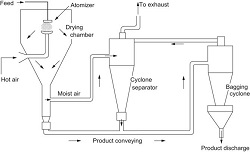
In this process, the sol is normally concentrated by partial evaporation of the solvent to form an aero-gel. The aero-gel is then fed into an enclosed chamber heated by hot air. The process chamber is similar to that used for atomization (see Image). The aero-gel is quite fluid and forms a spray so each droplet will, after evaporation, constitute the gel of the powder particles. The shrinkage of the individual drop may be quite high (on the order of 50%), and particles in the size range of 5 to 250 μm (0.2 to 10 mils) may be produced. These gel particles are calcined to form the feedstock for thermal spraying. The hot air is usually at 400 °C (750 °F), and the air leaving the spray-drying device is at 200 °C (390 °F). The process is not energy efficient for small batches of material. Spray drying of powders is also referred to as spray roasting because the process temperature may be quite high.
A spray-drying facility can also be used to agglomerate fine powders, presently in the 1 to 10 μm (0.04 to 0.4 mil) range. The particles are mixed in a slurry that contains a binder. The slurry is then atomized at elevated temperature, and the constituents form clusters of particles with the chemistry of the powders in the original slurry. The powder size is controlled by altering the nozzle geometry and the atomizing pressure. This process is not a true sol-gel method because the chemistry of the product is inhomogeneous. The method is attractive because of its flexibility in using raw materials, which are generally inexpensive, to produce free-flowing particles of a spherical morphology.
Spray drying consists of the following unit operations: pre-concentration of the liquid, atomization to create droplets, drying in a stream of hot, dry gas that is usually air, separation of powder from moist gas, cooling, and packaging of the product.
Relatively high temperatures are needed for spray-drying operations. Heat damage to products is generally only slight, however, because of an evaporative cooling effect during the critical drying period and because the subsequent time of exposure of the dry materials to high temperatures may be quite short. The typical surface temperature of a particle during the constant drying period is 45 to 50 °C (113 to 122 °F). For this reason, it is possible to spray dry some bacterial suspensions without destroying the organisms. The physical properties of the products are associated with the powder structure generated during spray drying. It is possible to control many of the factors that influence powder structure to obtain the desired properties.
Image – Spray-drying system.
This information is from ASM Handbooks Online, Vol. 5A: Thermal Spray Technology, Coating Structures, Properties, and Materials. To find this information (subscription required), click on the link below and scroll down to Figure 8.
https://dl.asminternational.org/handbooks/edited-volume/12/chapter/133823/Feedstock-Material-Considerations-for-Thermal