Electromagnetic wave pollution has become a growing concern due to the widespread use of electronic devices, prompting increased research into electromagnetic absorbing materials. Recently, focus has shifted to developing heterogeneous materials combining soft and hard magnetic components, though challenges like weak interfacial coupling and impedance mismatch remain, highlighting the need for precise control of their nanostructures to fully leverage magnetic interface engineering.
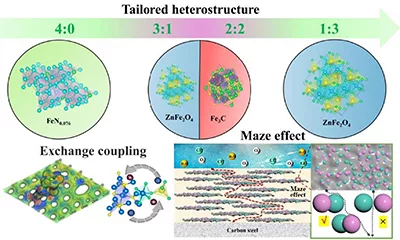
A team of material scientists led by Dong Wang from Shandong University of Technology, China recently studied the state of tailored hard/soft magnetic heterostructure for efficient microwave absorption and anti-corrosion property to advance research in the field. The synthesized Fe3C/ZnFe2O4/C (FZC) shows wide EAB of 4.56 GHz and RLmin value of -65.6 dB. By layer-to-layer stacking of two-dimensional (2D) FZC and reduced graphene oxide (rGO), the obtained flexible rGO/FZC-1 film can effectively shield 5G signals. Importantly, both the 2D morphology and abundant heterostructures restrain the diffusion of saline ions inside the FZC coatings and enhance the “maze effect”, finally improving the corrosion resistance in marine environment.
“In this research, we present a soft/hard magnetic heterostructures of ZnFe2O4/Fe3C, which are anchored on 2D carbon nanosheets, are successfully tailored by in-situ blowing gel process. Soft magnetic ZnFe2O4 nanoparticles and hard magnetic Fe3C nanoparticles are crosslinked with each other, forming a large number of heterogeneous interfaces. Such soft/hard magnetic heterogeneous interfaces generate sufficient magnetic exchange coupling interaction, and enhance polarization loss.
“Moreover, the clever introduction of 2D carbon sheets balances the impedance matching and endow the composites with dielectric loss. The synthesized Fe3C/ZnFe2O4/C-1 (FZC-1) shows wide EAB of 4.56 GHz and RLmin value of -65.6 dB. RCS simulation results further confirm that the FZC-1 has great application prospects in stealth coatings. Density functional theory (DFT) calculations demonstrate the exchange coupling effect, which results from the dynamic charges reconstruction of soft and hard magnetic heterogeneous interface. Moreover, by layer-to-layer stacking of 2D FZC and reduced graphene oxide (rGO), the obtained flexible rGO/FZC-1 composite film can effectively shield 5G signals. Importantly, both the 2D morphology and abundant heterostructures restrain the diffusion of saline ions inside the FZC coatings and enhance the “maze effect”, finally greatly enhancing the corrosion resistance in marine environment,” said Dong wang, senior author, a professor in the School of Materials science and Engineering at Shandong University of Technology and vice president of the Institute of Engineering Ceramics.
For more information: Nano Research
Image: Tailored soft/hard magnetic heterostructures of ZnFe2O4/Fe3C, which are anchored on two-dimensional (2D) carbon nanosheets, are synthesized by high temperature gel blowing process. Benefitting from the integration of soft/hard magnetic heterostructure, carbon component, and 2D morphology, the obtained 2D Fe3C/ZnFe2O4/C shows excellent electromagnetic wave (EMW) absorbing performance and high corrosion resistance.