Scientists at Penn Engineering, Penn Arts & Sciences, and Aarhus University found that adding just the right amount of disorder to the structure of certain materials can make them more than twice as resistant to cracking.
The finding opens the door to more widespread use of so-called “mechanical metamaterials,” a class of materials whose internal structures—often produced via digital manufacturing techniques such as 3D printing and laser cutting—give them unique properties, including enhanced strength or stiffness per weight.
Until this point, one of the greatest challenges posed by mechanical metamaterials has been their fragility. “Toughness is a limiting factor in not all, but many 3D-printed mechanical metamaterials,” says Kevin Turner, professor and John Henry Towne Department Chair of Mechanical Engineering and Applied Mechanics (MEAM) at Penn Engineering and the paper’s senior author. “Without changing the material at all, just simply by altering the internal geometry,” says Turner, “you can increase the toughness by 2.6 times.”
To test whether disorder makes mechanical metamaterials tougher, the researchers performed thousands of computational mechanics simulations of numerous different patterns, all based on a triangular lattice, called a truss. In some, the triangles were arranged in perfect symmetry, while in others, the pattern had been perturbed by moving the nodes where the triangles meet.
When they attempted to break the materials—in the lab and in the simulations—a clear trend emerged. “There was a specific level of disorder, so that the patterns we cut into the material looked somewhat regular but not exactly symmetrical, where we were able to achieve the highest level of performance,” says Sage Fulco, a postdoctoral researcher in MEAM and the paper’s lead author.
The perfect level of disorder—not too little, or too much—retained most of the material’s strength and stiffness while enhancing its toughness, but took substantially more effort to design than a repeating structure.
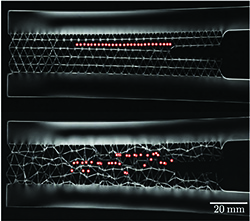
By taking images of samples with different patterns—some with a regular pattern and others with varying levels of disorder—while loading them to failure, the researchers were able to visualize exactly what happened as cracks propagated through the materials. In short, the disorder prevented cracks from traveling in straight lines.
Ultimately, the team envisions these advances leading to the development of improved materials and structures with applications in industries like aerospace, where resisting crack growth and tolerating damage are critical. “We’re enabling broader use of mechanical metamaterials in structural applications by identifying a geometric route to increase toughness,” says Turner.
Image – In contrast to the more structured design (top), the more disordered one (bottom) cracked less easily, as evidenced by the dispersion of the red dots. Courtesy of Sage Fulco.
************
For more information:
University of Pennsylvania