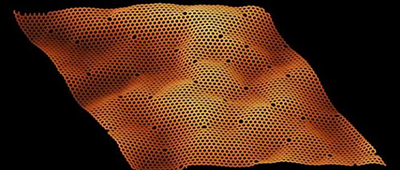
Researchers from the University of Cambridge have shown that ripples in two-dimensional materials, like graphene, significantly influence fluid interactions, strength, conductivity, and chemical activity. Understanding how rippling and defects interact is essential for advancing technologies such as energy storage, flexible electronics, nanofluidics, and catalysis. Defects can dramatically alter the surface ripples, sometimes causing the material to freeze in place, similar to a still image.
Dr. Fabian Thiemann, the first author of the study, is currently a Research Scientist at IBM. He began this research while pursuing his Ph.D. at UCL, the University of Cambridge, and Imperial College London.
2D materials are central to technological advancements in areas such as water filtration, high-speed electronics, and ultra-thin flexible displays. However, at the atomic level, surfaces that appear flat are never truly flat. These 2D surfaces contain microscopic ripples that influence their properties.
The researchers used machine learning-based computer models to simulate 2D sheets of graphene and other materials. These models allowed them to examine how different materials, both with and without defects, exhibit rippling behavior. They discovered that defects in the material affect how ripples propagate and, more significantly, cause the membrane to freeze and lose its flexibility when defect concentrations are high.
Dr. Camille Scalliet, currently a Permanent Researcher at the Laboratoire de Physique de l’École Normale Supérieure in Paris, conducted this research while serving as a Herchel Smith Postdoctoral Fellow at the University of Cambridge.
The researchers are excited to expand on these findings in the future. Fabian Thiemann and Camille Scalliet discussed their thoughts on the future of their study: “There are great ways to continue this work. Our next steps are to study more complicated situations at the nanoscale, such as membranes in contact with water or other materials. This is just the beginning of this collaboration.”
For more information: Proceedings of the National Academy of Sciences
Image: Defects in a flexible sheet