When producing ultra-strong steel parts for vehicles, military gear, and heavy manufacturing, even minor cracks or distortions during heat treatment can cause significant delays and material waste. Dr. Kingsley Amatanweze, a recent Ph.D. graduate from the Missouri University of Science and Technology (S&T), has developed new methods to reduce these costly issues by improving the induction melting, pouring, and cooling processes of steel. His research focused on a high-strength, lightweight steel alloy containing chromium, molybdenum, and nickel, aiming to enhance reliability and performance. Guided by Dr. Laura Bartlett, his work offers promising advancements for the steel manufacturing industry.
Amatanweze, of Nigeria, primarily researched an ultrahigh-strength, lightweight steel alloy that includes chromium, molybdenum and nickel. His advisor was Dr. Laura Bartlett, S&T’s Robert V. Wolf Associate Professor of Metallurgical Engineering and Foundry Educational Foundation Key Professor of Metalcasting Technology.
Amatanweze examined how parts are hardened during the final stage of production, known as quenching, and compared a water-spray quench method developed at S&T to the traditional immersion process involving oil or water and found that the spray technique provided more even cooling and reduced the risk of cracks—especially in parts with complex shapes.
“Based on our results, this spray method is a promising alternative for industries that want stronger parts with fewer defects and for manufacturers looking to cut waste and improve efficiency,” he says. “Using water is also cleaner, safer and more sustainable than using oil.”
Amatanweze also worked on methods to produce cleaner, higher-quality steel castings during other manufacturing stages. For the melting stage, he identified how adding a dome cover and increasing the volume of argon gas over the molten steel can limit nitrogen absorption, which can cause tiny gas pockets and weaken the final product.
He fine-tuned the timing for adding alloys to steel and reduced how long the steel remains molten after reaching the target temperature, which also helps to minimize nitrogen gas absorption.
For the mold-filling stage, he researched new designs for the gating, or channels that guide liquid steel into molds, to reduce turbulence and trap impurities.
“What’s so fascinating about materials science is how this field has been around for thousands of years in different forms, yet we’re still finding new and incredible ways to make a real difference in 2025,” he says. “I especially love metallurgical engineering because it touches nearly every part of modern life—from infrastructure and vehicles to buildings and advanced technology.”
Amatanweze’s passion for his field has led to international recognition when he was selected as a student member of ASM International’s board of trustees in 2023 and earned the 2024 ASM Best Student Paper Award for his research.
Amatanweze says he has always been excited to promote the importance of metallurgical engineering but having Bartlett as his advisor helped take it to a new level.
“She is amazing with public outreach and explaining to everyone the importance of our field and the work we do,” he says. “I had such supportive professors at Missouri S&T who truly care about their students and about preparing us to hit the ground running after earning our degrees.”
For more information: Missouri S&T
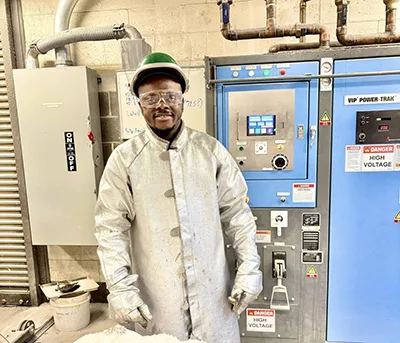
Image: Dr. Kingsley Amatanweze in Missouri S&T’s Robert V. Wolf Foundry. Photo courtesy of Paul Agwaza.