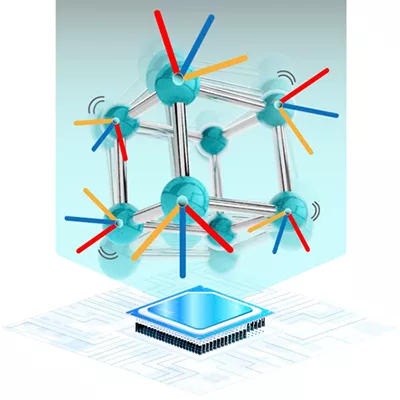
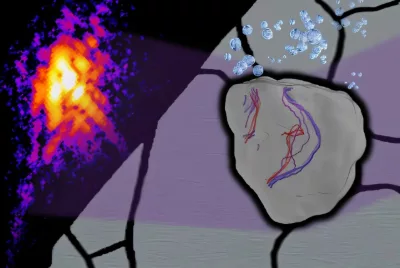
Now, inspired by recent advances in machine learning, Bernardi and Luo have developed an AI-based technique that sifts through the high-order tensors that encode phonon interactions in a material and extracts only the crucial bits needed to complete the calculations that explain thermal transport.
“The calculations for four-phonon interactions are a nightmare,” Bernardi says. “For complex materials, this task would involve weekslong calculations. Now we can do them in 10 seconds.”
Bernardi explains more about the method:
“We use a machine learning technique called CANDECOMP/PARAFAC tensor decomposition, but we had to adapt it to satisfy the symmetry of this specific physical problem. We first set up a neural network and then run it on GPUs and ask: ‘What are the best functions to approximate the actual tensor that describes these phonon interactions?’ Once we fix the number of product terms we want to keep, the machine learning process returns the best functions to approximate the full tensor. We typically only need a few of these products, saving orders of magnitude in computational complexity compared to using the full tensor. This method allows us to learn the compressed form of phonon interactions, and we can still use these highly compressed tensors to compute all the observables of interest with the same accuracy.”
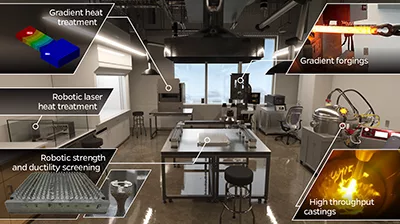
Bernardi adds that the new method is well suited for high-throughput screening of thermal physics and heat transport in large material databases, a major effort in the materials community. As for future work, he says, “My vision right now is to compress all different types of quantum interactions and high-order processes in materials with similar techniques. The key will be to bypass the formation of large tensors altogether and to learn the interactions directly in compressed form.”