Researchers at the University of Michigan have developed a breakthrough method that brings quantum-level precision to molecular modeling, offering deeper insights into chemical reactions and material properties. This advancement addresses the quantum many-body problem—how electrons interact to form chemical bonds and influence electrical behavior—which traditionally requires immense computational power and is limited to small molecules. By enhancing the efficiency of this simulation approach, the new method could extend quantum accuracy to larger, more complex systems, potentially reducing the heavy demand on national lab supercomputers.
Density functional theory, or DFT, makes quantum chemistry more manageable by focusing on electron densities rather than tracking every electron individually. This approach keeps computing demands much lower, allowing simulations of systems with hundreds of atoms. A major challenge, however, lies in the exchange-correlation (XC) functional, which governs how electrons interact according to quantum mechanics.
Until now, researchers have had to rely on approximations of the XC functional tailored to specific applications, limiting the theory’s overall accuracy. Improving this functional is key to making DFT an even more powerful tool for chemistry and materials science.
According to Vikram Gavini, a University of Michigan professor of mechanical engineering and the corresponding author of the study, researchers know that a universal functional exists that applies to all electron systems – whether in molecules, metals, or semiconductors – but its exact form remains unknown.
Hence, understanding this functional is crucial for improving DFT, which models electron interactions and underpins simulations in chemistry and materials science.
Given DFT’s central role in advancing both materials research and basic science, the US Department of Energy provided funding and supercomputer resources to support the University of Michigan team’s efforts to approach the universal exchange-correlation functional.
The researchers began by analyzing individual atoms and small molecules using quantum many-body theory. Then, instead of applying approximate functionals to predict electron behavior, they used machine learning to determine which XC functional would reproduce the electrons’ behavior as calculated by the more precise quantum many-body method.
Bikash Kanungo, a University of Michigan assistant research scientist in mechanical engineering and first author of the study, explains that an accurate exchange-correlation functional has broad applications because it is material-agnostic.
It is equally important for researchers developing better battery materials, designing new drugs, or building quantum computers. By improving this functional, scientists can make density functional theory more reliable and widely applicable, enabling more precise simulations across chemistry, materials science, and emerging technologies.
Thus, researchers can now use the XC functional discovered by the University of Michigan team or apply their approach to new systems, starting with light atoms and molecules and eventually extending to solids, paving the way for more accurate and efficient simulations across chemistry and materials science.
For more information: University of Michigan
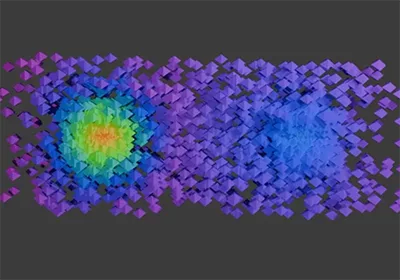
Image: A 3D map of the quantum potential.