Stainless steel is widely known for its corrosion resistance. But when it is exposed to environments containing chloride ions, such as seawater, the risk of corrosion increases. Manufacturers typically grind the surface to smooth it. However, this finishing process reduces corrosion resistance even further. Researchers at Tohoku University in Japan have recently shed light on why this occurs.
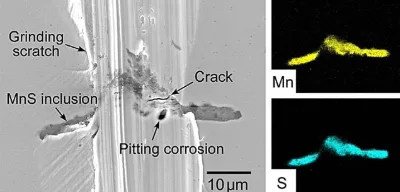
They found that grinding leaves fine scratches on the surface, which can cut into tiny manganese sulfide particles embedded within the steel. Where these scratches intersect with manganese sulfide particles, the surface becomes more vulnerable to damage.
Using Type 304 stainless steel, the team studied corrosion behavior in saltwater conditions. The grinding step alone did not trigger corrosion; instead, pitting occurred only in regions containing manganese sulfide (MnS) particles. This indicates that surface scratches by themselves are insufficient to weaken corrosion resistance and that MnS inclusions play a key role in the process.
The researchers then examined how grinding alters both the protective surface layer and the MnS inclusions. While the chemical composition of the protective layer remained largely unchanged, its thickness became uneven after grinding. In contrast, the MnS inclusions suffered significant damage—they were deformed, cracked, and in some cases forced deeper into the steel.
“These changes to the MnS inclusions caused by grinding were the most important factor behind the reduced resistance to pitting corrosion,” explained Masashi Nishimoto, an author of the study and professor in Tohoku University’s Department of Engineering. “Ultimately, we showed that grinding lowers resistance not only by disrupting the protective layer, but mainly by damaging MnS inclusions at the same time.”
Nishimoto and his colleagues hope that clarifying the effects of surface finishing on corrosion will lead to improved guidance for grinding and surface-treatment methods that minimize risk. They indicate that future strategies will need to address the harmful impact of MnS inclusions after grinding. This could enhance the durability and reliability of stainless-steel components used in chemical plants, industrial machinery, and medical devices, where surface finishing is critical.
The researchers published their findings in the journal npj Materials Degradation.
Image – SEM image and elemental maps of MnS inclusions on a stainless-steel surface subjected to rough grinding. Courtesy of Siqi Wang, Masashi Nishimoto, and Izumi Muto.
************
For more information:
Tohoku University