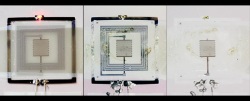
Researchers at the University of Illinois, Champaign, have reportedly developed heat-triggered self-destructing electronic devices. The devices have magnesium circuits printed on very thin, flexible materials. The researchers trap microscopic droplets of a weak acid in wax, and coat the devices with the wax. When the devices are heated, the wax melts, releasing the acid. The acid dissolves the device quickly and completely.
The researchers can control how fast the device degrades by tuning the thickness of the wax, the concentration of the acid, and the temperature. They can design a device to self-destruct within 20 seconds up to a couple of minutes after heat is applied. The devices also can degrade in steps by encasing different parts in waxes with different melting temperatures. This gives more precise control over which parts of a device are operative, creating possibilities for sophisticated devices that can sense something in the environment and respond to it.
To remotely trigger the reaction, engineers embedded a radio-frequency receiver and an inductive heating coil, shown in the center of the device in the photo. The user can send a signal to cause the coil to heat up, which melts the wax and dissolves the device.
The researchers, led by aerospace engineering professor Scott R. White, published their work in the journal Advanced Materials. “We have demonstrated electronics that are there when you need them and gone when you don’t need them anymore,” Prof. White says. “This is a way of creating sustainability in the materials that are used in modern-day electronics. This was our first attempt to use an environmental stimulus to trigger destruction.”
Prof. White’s group teamed up with Prof. John A. Rogers, Swanlund chair in materials science and engineering and director of the Frederick Seitz Materials Laboratory at Illinois. Prof. Rogers’ group pioneered transient devices that dissolve in water, with applications for biomedical implants. Together, the two multi-disciplinary research groups have tackled the problem of using other triggers to break down devices, including ultraviolet light, heat, and mechanical stress. The goal is to find ways to disintegrate the devices so that manufacturers can recycle costly materials from used or obsolete devices, or so that the devices could break down in a landfill.
Watch a video of the researchers demonstrating and explaining the devices at https://www.youtube.com/watch?v=Tdj915k5gKg.
The paper, “Thermally triggered degradation of transient electronic devices,” is available online at http://onlinelibrary.wiley.com/doi/10.1002/adma.201501180/full.
http://news.illinois.edu/news/