Researchers from the California NanoSystems Institute at UCLA have reportedly developed a new technique that greatly enhances digital microscopy images.
The development is significant because digital imagery has led to many advances in microscopy, but digital microscopic imaging can sometimes result in blurry, pixelated images.
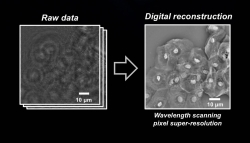
The new technique is called wavelength scanning pixel super-resolution. It is based on a device that captures a stack of digital images of the same specimen, each with a slightly different wavelength of light. Then, researchers apply a newly devised algorithm that divides the pixels in each captured image into a number of smaller pixels, resulting in a much higher-resolution digital image of the specimen.
The research team was led by Aydogan Ozcan, Chancellor’s Professor of Electrical Engineering and Bioengineering at the UCLA Henry Samueli School of Engineering and Applied Science. The study appears in the journal Light: Science and Applications, which is published by the Nature Publishing Group.
“These results mean we can see and inspect large samples with finer details at the sub-micron level,” Prof. Ozcan said. “We have applied this method to lens-based conventional microscopes, as well as our lensless on-chip microscopy systems that create microscopic images using holograms, and it works across all these platforms.”
The first author of the study is UCLA graduate student Wei Luo; the other authors were graduate students Yibo Zhang and Alborz Feizi and postdoctoral scholar Zoltan Gorocs.