A team of researchers from three universities reports that amorphous silicon can be grown into superelastic horseshoe-shaped crystalline nanowires that can undergo stretching of more than twice their original length, and still maintain their excellent electric properties. The researchers, who are from Nanjing University, Peking University, and CNRS-Ecole Polytechnique, have published a paper on their new method for growing stretchable silicon springs in a recent issue of Nano Letters.
Results suggest that silicon nanowire springs could serve as a stretchable semiconducting material for future flexible, bendable electronic devices. So far, almost all of the stretchable electronics that have been demonstrated have been made of polymer and organic semiconductors, whose semiconducting properties are inferior to those of silicon.
As the researchers explain in the new paper, one ideal and relatively inexpensive method for making stretchable silicon nanowires would be similar to the crystal pulling methods used to grow silicon crystal ingots from molten silicon. In these methods, which are widely used in the silicon industry, a seed crystal is dipped in molten silicon and slowly pulled upward, drawing with it a long crystalline silicon ingot.
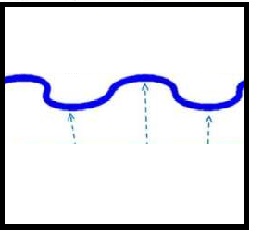
The new method is somewhat like a nanoscale in-plane version of crystal pulling. The process, called line-shape engineering, involves guiding molten indium droplets to move along a pre-patterned track that is coated with amorphous silicon. As the droplet moves along the track, it takes in amorphous silicon and precipitates crystalline silicon nanowires.
In their demonstrations, the researchers grew crystalline silicon nanowires more than a millimeter long into patterns such as horseshoe shapes and a Peano curve, which has previously been shown to be one of the best fractal patterns for achieving large stretchability. In previous work, the researchers had demonstrated the guided growth of silicon nanowires in straight lines, but the ability to grow them in tightly curved patterns like these is essential for achieving stretchability. Tests revealed that the springs can be pulled to more than twice their original length—almost into a straight line—while maintaining their electric properties and quickly recovering their original shape when released.
In the future, the researchers plan to investigate techniques for transferring the silicon nanosprings from the growth substrate onto a softer surface that is more practical for applications. Overall, they expect that the growth method demonstrated here represents an important step toward developing high-performance, stretchable silicon electronics.
https://phys.org/news/2018-01-hard-to-stretch-silicon-superelastic.html#jCp