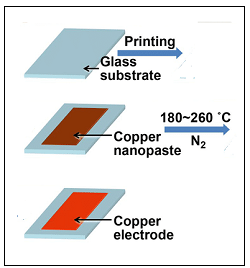
Scientists at Tohoku University in Japan report that they fabricated an electrode by printing copper nanoparticle-based nanopastes onto a glass substrate using a metal screen mask and pressureless sintering under a nitrogen atmosphere at 200°C for 30 minutes. The electrical resistivity of the resulting copper electrode was 16 μΩ · cm.
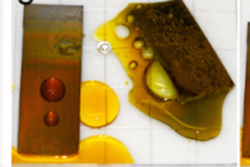
For a metal-to-metal bonding test, copper nanopaste was printed onto an oxygen-free copper plate, then another oxygen-free copper plate was placed on top. The bonding strength between the copper plates when pressureless sintered under a nitrogen atmosphere at 200°C for 30 min was 39 MPa. TEM observations confirmed that highly crystalline metal bonding occurred between the copper NPs and the copper plate to introduce the ultrahigh strength.
The copper nanoparticles (NPs) with an average particle diameter of 50–60 nm were successfully produced by reducing an aqueous solution of a copper(II)-nitrilotriacetic acid complex with an aqueous hydrazine solution at room temperature under an air atmosphere. The developed copper NPs could provide promising advances as nanopastes for sustainable fabrication of copper electrodes and die attachment materials for the production of next-generation power semiconductors.
The above is the abstract of “Ambient Aqueous-Phase Synthesis of Copper Nanoparticles and Nanopastes with Low-Temperature Sintering and Ultra-High Bonding Abilities.” It was published in the online journal Scientific Reports.
The complete article is available here: https://www.nature.com/articles/s41598-018-38422-5