A research team at the Korea Advanced Institute of Science and Technology (KAIST), South Korea, analyzed the materials research projects reported by leading global institutes and research groups and derived a quantitative model of new materials and processes using machine learning with a scientific interpretation.
The M3I3 Initiative – Materials and Molecular Modeling, Imaging, Informatics and Integration – has led to new insights into advancing materials development by implementing breakthroughs in materials imaging that have created a paradigm shift in materials discovery. It features multi-scale modeling and imaging of structure and property relationships and materials hierarchies combined with the latest material-processing data.
The researchers discussed the role of multi-scale materials and molecular imaging combined with machine learning and also presented a future outlook for developments and the major challenges of M3I3. By building this model, the research team envisions creating desired sets of properties for materials and obtaining the optimum processing recipes to synthesize them.
“The development of various microscopy and diffraction tools with the ability to map the structure, property, and performance of materials at multi-scale levels and in real time enabled us to think that materials imaging could radically accelerate materials discovery and development,” says Professor Hong, research team leader.
“We plan to build an M3I3 repository of searchable structural and property maps using Findable, Accessible, Interoperable, and Reusable (FAIR) principles to standardize best practices as well as streamline the training of early career researchers,” said Hong.
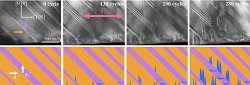
One example of the power of structure-property imaging at the nano-scale level is the development of future materials for emerging nonvolatile memory devices. The team focused on microscopy using photons, electrons, and physical probes on the multi-scale structural hierarchy, as well as structure-property relationships to enhance the performance of memory devices.
“M3I3 is an algorithm for performing the reverse engineering of future materials. Reverse engineering starts by analyzing the structure and composition of cutting-edge materials or products. Once the research team determines the performance of our targeted future materials, we need to know the candidate structures and compositions for producing the future materials,” Hong said.
The research team built a data-driven experimental design based on traditional NCM (nickel, cobalt, and manganese) cathode materials and expanded their future direction for achieving higher discharge capacity via Li-rich cathodes.
Due to having limited data describing Li-rich cathode properties, the team proposed building a machine-learning-guided data generator for data augmentation and using a machine-learning method based on transfer learning.
Since the NCM cathode database shares a common feature with a Li-rich cathode, one could consider repurposing the NCM trained model for assisting the Li-rich prediction. With the pre-trained model and transfer learning, the team expects to achieve outstanding predictions for Li-rich cathodes even with the small data set.
With advances in experimental imaging and the availability of well-resolved information and big data, along with significant advances in high-performance computing and a worldwide thrust toward a general, collaborative, integrative, and on-demand research platform, there is a clear confluence in the required capabilities of advancing the M3I3 Initiative.
Image – Schematic diagram of the M3I3 Flagship Project, aiming to seamlessly integrate multi-scale “structure-property” and “processing-property” relationships via materials modeling, imaging, and machine learning. With AI-guided automatic synthesis, M3I3 will provide expedited development of new materials in the near future. Courtesy of KAIST.
For more information:
The Korea Advanced Institute of Science and Technology
https://www.kaist.ac.kr/en/