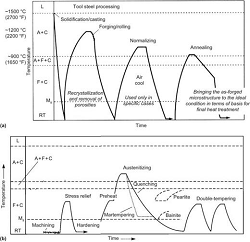
After hot forming, tool steel usually is submitted to heat treatment processes that may be split into two major steps. These are shown here in a graphical form illustrating the typical processing and heat treatment sequences, splitting them into the steps done before hardening and those done for hardening, as a function of time, temperature, and phase transformation.
The first step is done to produce a low-hardness condition, which is important to machining, but which also should promote a homogeneous microstructure, usually referred to as the annealed condition. The second step involves this homogeneous microstructure being converted to a higher-hardness condition, usually by martensite formation during the hardening and tempering heat treatments.
For more information, click on the link below (subscription required). Then scroll to Figure 1.
Rafael A. Mesquita; Reinhold E. Schneider, Introduction to Heat Treating of Tool Steels, Vol 4D, ASM Handbook, Edited By Jon L. Dossett, George E. Totten, ASM International, 2014, https://doi.org/10.31399/asm.hb.v04d.a0005946.