Researchers at Lawrence Livermore National Laboratory, Livermore, Calif., have furthered a new type of soft material that can change shape in response to light, a discovery that could advance “soft machines” for a variety of fields, from robotics to medicine.
The novel material, called a liquid crystal elastomer (LCE), is made by incorporating liquid crystals into the molecular structure of a stretchable material. Adding gold nanorods to the LCE material, scientists and engineers created photo-responsive inks and 3D printed structures that could be made to bend, crawl and move when exposed to a laser that causes localized heating in the material. The results were recently published in the journal Matter.
The LLNL team, along with collaborators from Harvard University, North Carolina State University and the University of Pennsylvania, used a direct ink writing printing technique to build a variety of light-responsive objects, including cylinders that could roll, asymmetric “crawlers” that could go forward and lattice structures that oscillated. By combining shape morphing with photoresponsivity, researchers said the new type of material could change the way people think about machines and materials.
“At LLNL, we’ve focused on developing static materials and architectures for some time,” said principal investigator Caitlyn Krikorian (Cook). “We’ve made these complex types of structures like hierarchical lattices, and we’ve even started exploring more responsive materials, like shape memory polymers that have a one-time shape memory response. But the Lab really hadn’t delved deep into creating architectures that can go from a 3D-to-3D type of shape change. This project is starting to show how architecture and these novel materials can have unique modes of actuation that we haven’t researched before.”
Researchers said the new material could be used to create a “soft machine” — a type of machine made from these flexible LCE composite materials — capable of responding to external stimuli and even mimicking the movements and behaviors of living organisms. Soft robots made of the shape-morphing material could crawl, swim or fly, and explore environments that are too difficult or dangerous for humans to access, like caves or outer space. Soft machines could also be used in medical applications, such as implantable devices that can adapt to the body’s movements, or prosthetic limbs that move like natural limbs, and other applications that aren’t possible with machines made from rigid materials, like metal or plastic.
The movement of the LCE material is driven primarily by a process known as photothermal actuation, which involves converting light energy into thermal energy resulting in a mechanical response from the material. Driven by the interaction between light, gold nanorods and the LCE matrix, the process enables the printed structures to exhibit dynamic and reversible movements in response to external stimuli.
This composite material – gold nanorods in liquid-crystal elastomers – has a photothermal effect. Infrared light creates a heating effect, which causes the aligned molecules to become misaligned. During that misalignment process, with uniform heating there’s a global shape change. But in this case, localized heating produces localized regions of shape morphing that can do things like locomotion.
In the study, researchers used a computer vision system, involving cameras and a tracking software, to control the movement of a printed cylinder. The tracking system monitored the position of the rolling cylinder and continuously adjusted the position of the laser to raster the edge of the cylinder. This continuous tracking and adjustment allowed for the cylinder to maintain its rolling motion in a controlled manner.
By leveraging computer vision with the photothermal actuation of the cylinder, the researchers achieved a sophisticated level of manipulation of the soft machine’s movement, showcasing the potential for advanced control systems in the field of soft robotics and soft machines. The team also showed that responsivity could be controlled so the soft machines could perform useful tasks, such as a moving cylinder carrying a wire.
In more complex modes of motion using a variety of rastering speeds and light intensities, high performance computing (HPC) simulations aren’t sufficient since they expect a uniform heating or stimuli on the printed lattice. Computer vision and machine learning that learn the actuation speeds and what doses of light can cause locomotion from in the printed architectures will further advance understanding the materials’ response.
Researchers said there are still some challenges that need to be overcome before the material can be used in practical applications. The team found that structures they created could flip over or exhibit other unpredictable motion, thereby making it difficult to design specific modes of motions. Work will continue on models that can describe the complex motion to better design future machines and develop new materials and manufacturing techniques to create soft machines that are more durable, reliable and efficient for a variety of applications. New control systems and computer algorithms also could enable soft machines to move and interact with their environment in a more intelligent and autonomous way.
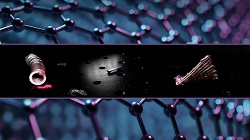
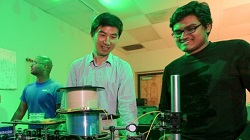
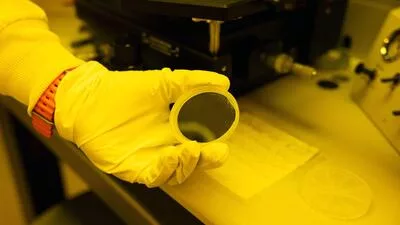
Image – Lawrence Livermore National Laboratory researchers and their collaborators have created a new responsive material called a liquid crystal elastomer, made by incorporating liquid crystals into the molecular structure of a stretchable material. Adding gold nanorods to the material, the researchers created photo-responsive inks and 3D printed structures that could be made to bend, crawl and move when exposed to a laser light. Courtesy of: Michael Ford.
For more information:
Livermore National Laboratory