A new study conducted by researchers from the University of Delaware’s Center for Composite Materials (CCM) and DuPont Specialty Products, Wilmington, Del., now provides insights about a composite material that can be used to make thin, flexible and durable circuit boards.
Published in the journal ACS Applied Materials and Interfaces, the study describes how the components of the circuit boards can be more efficiently bound together and provides a framework for how to create new materials that are compatible with high-speed electronic applications.
The circuit boards used in this study are fabricated from thin sheets of copper foil laminated with polyimide, a high-performance polymer created by DuPont for electronic applications. The polyimide not only acts as the dielectric (or electric insulator) between each copper layer, but it also must maintain adhesion with the copper layers to ensure long-term durability.
This study explored the trade-offs between the effects of surface roughness on the transmission of electromagnetic waves and interfacial adhesion, especially crucial at the increased frequencies required for high-speed electronic devices.
“You can’t get those transmission speeds unless the copper is smooth,” said Mark Lamontia, retired DuPont project manager and paper co-author. “But the smoother you make the copper, the adhesion between the copper and the polyimide gets tougher to achieve.”
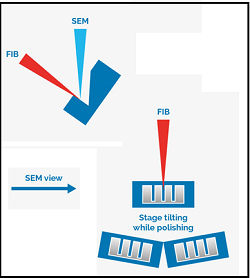
The first step was to improve their procedure for measuring adhesion between the copper and the polyimide. To do this, CCM researchers developed a way to conduct the industry standard “peel test” (akin to pulling a piece of scotch tape from a surface) and collecting analytical chemistry data from the failure surface. This enabled them to gain deeper insights on the adhesion mechanisms between copper and polyimide through a process known as a failure analysis.
“This copper film and the polyimide bound to it is only 30 to 50 microns thick, so it’s a really thin and delicate material,” said Sagar Doshi, CCM associate scientist and first author of this paper.
“For testing these highly specialized materials, we had to innovate and modify the typically used experimental setup and carefully preserve the tested samples for detailed failure analysis using different materials characterization techniques.”
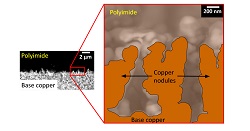
Armed with an improved way to measure adhesion, the researchers then used this technique to study the adhesion mechanism between the copper and the polyimide. What they found was surprising: As the highly viscous polymer infiltrated around the rough nodules on the copper’s surface, the compression molded polyimide/copper laminate formed a mechanical interlock.
“This is the first time in this industry that I’ve seen this happen,” added Lamontia about the evidence for this mechanical interlocking mechanism in this type of laminate material.
What was additionally surprising, added Doshi, is that the mechanical interlock was due to the overall structure, or topography, of those copper nodules.
“Once the polyimide goes into certain regions, it’s locked in there. When we peel it off, it has to break through the copper in order to come off,” Doshi said. “Another key aspect of the study was the process modeling of the mechanical interlocking mechanism, where we predicted polymer infiltration into the surface pores as a function of process temperature, pressure and pore size. In this paper, we show that, when the material is optimized for mechanical interlocking, the peel strength increases by a factor of three.”
Not only did the researchers demonstrate the role of mechanical interlocking for these materials, they can now use this thorough mechanistic understanding of adhesion to study how different factors and experimental conditions impact the mechanical interlocking between polyimide and copper. This will allow researchers across the field to continue developing innovative materials that can meet the needs of current and future high-speed electronics.
Image – While delving into the adhesion mechanism between the polyimide and copper, the researchers found that, as the highly viscous polymer filled in the spaces around the rough copper nodules, it formed a mechanical interlock. Courtesy of: Sagar Doshi, Joy Smoker.
For more information:
DuPont Specialty Products
University of Delaware’s Center for Composite Materials