The world record for thinnest pasta has just been shattered.
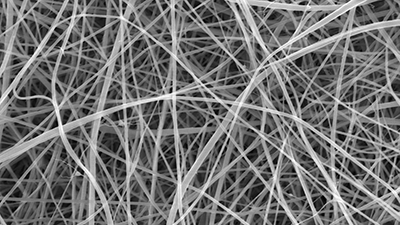
A team of researchers has created starchy nanofibers from white flour, with an average thickness of about 370 nanometers, or roughly two-hundredths the thickness of a human hair. These nanofibers, produced by mixing flour with formic acid to uncoil the starch molecules, are being explored for use in biodegradable bandages rather than as food.
“Normally, if you want to cook starch, then you use water and heat to break up the tight packing of starch,” notes Adam Clancy. “We do that chemically with formic acid. So we effectively pickle it instead of cooking it.”
Clancy is a chemist at University College London in England. He was part of a team that warmed this dough to give it the right consistency. To stretch the dough into tiny noodles, they used a technique called electrospinning.
In this process, an electrical charge pulled the dough through a needle and onto a plate several centimeters away. The starch molecules tangled with each other as they left the needle, forming a jet. As the jet flew through the air, the formic acid evaporated. This left behind a thin fiber. After about 30 minutes, the fiber formed a thin mat on the plate.
This isn’t the first time someone has made a mat of starchy nanofibers. Such mats typically have tiny holes called pores. These pores are large enough to let water molecules through, but too small for bacteria to enter. That makes them good options for bandages and wound dressings.
But past research has electrospun mats using pure starch, as opposed to a starch-containing flour. The process of extracting pure starch from plant matter takes a lot of energy and water. The new study shows such costly extraction isn’t always needed.
Since the fibers are made of dried flour, they count as pasta, the authors say. That makes them the thinnest pasta on record.
Each noodle is roughly a thousandth the width of su filindeu. That’s a type of pasta about half the width of angel hair noodles, which are about 1 millimeter (0.04 inch) thick when cooked.
So is Clancy’s nanopasta edible? “I certainly hope so,” he says.
For more information: Nanoscale Advances
Image: These nanofibers (seen under a scanning electron microscope) can be called pasta because they are made from dried flour. That makes them the thinnest noodles ever.