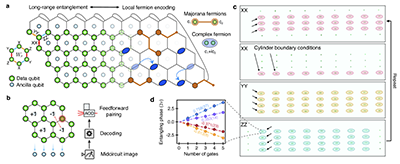
Researchers from Harvard University, MIT, and QuEra Computing Inc. have developed a new digital quantum simulation architecture based on reconfigurable atom arrays to simulate fermionic systems on quantum computers. This approach aims to advance materials science, chemistry, and high-energy physics by improving simulations of complex quantum materials and exotic phases of matter, which are challenging to study with classical computational methods. Fermions, such as electrons, protons, and neutrons, obey the Pauli exclusion principle, making their simulation difficult due to non-local interactions where changes in one part of the system can affect distant parts.
The research team used a quantum computing method that maps fermionic behavior onto qubits by leveraging a model known as Kitaev’s honeycomb lattice. This mathematical framework describes how particles interact in a two-dimensional honeycomb-shaped grid. The Kitaev model is particularly useful because it allows researchers to study exotic phases of matter, including spin liquids — materials where magnetic moments remain disordered even at very low temperatures. The approach encodes fermionic statistics using long-range entangled states to allow for more efficient quantum simulations of strongly interacting systems.
The study confirms the existence of a non-Abelian spin liquid phase by measuring an odd Chern number, a key mathematical indicator of topological order. Non-Abelian states are special because the way particles interact depends on the order in which they are exchanged. Unlike conventional particles, which either return to their original state or flip when swapped, non-Abelian particles retain a memory of the sequence of swaps, making them useful for robust quantum computing.
Although it’s not exact, to grasp some idea of the concept, you could think of non-Abelian states like a combination lock — if you enter the numbers in a different order, it will give you a different result. On the other hand, conventional particles are like light switches, which only have two states regardless of how many times you flip them.
The odd Chern number serves as a topological signature that identifies different quantum phases, much like how a fingerprint identifies an individual.
The work demonstrates how quantum simulations can efficiently capture the essential physics of strongly correlated fermions, according the researchers.
By encoding fermionic interactions in a topologically ordered state, the system enables precise control over the quantum evolution of fermions. Topological states are quantum states of matter that depend on their overall structure rather than specific local details. These states are particularly important because they provide robust ways to store and manipulate quantum information, making them valuable for fault-tolerant quantum computing.
Quantum simulations of fermionic systems are particularly challenging due to the non-local nature of fermion interactions. Traditional quantum computing methods require complex encodings that can introduce significant computational overhead. The researchers overcame these challenges using measurement-based state preparation, tunable Floquet circuits, and error detection techniques. Floquet engineering, which is a method that uses periodic driving to control quantum interactions, played a crucial role in simulating fermionic behavior in a controllable manner.
In the experiment, the team used a reconfigurable array of 104 atomic qubits on a neutral-atom quantum computing platform to represent the honeycomb lattice. They employed Floquet engineering to simulate fermionic behavior. Through this method, they successfully prepared and verified various low-energy states, including those corresponding to topological spin liquids. These spin liquids are phases of matter that, unlike conventional magnets, do not exhibit long-range magnetic order but instead host highly entangled quantum states with exotic properties such as fractionalized excitations.
One of the study’s major findings is the ability to simulate strong interactions within a fermionic system, particularly in the context of the Fermi-Hubbard model. This model is widely used in condensed matter physics to describe electron interactions in materials and has implications for understanding high-temperature superconductivity. By engineering interactions among fermions on a square lattice, the researchers were able to explore dynamics relevant to real-world materials, potentially providing insights into novel electronic properties that could be harnessed in future technologies.
Despite these advances, the study acknowledges several limitations that will likely be the focus of future work, as we’ll see later. Quantum errors remain a significant challenge, limiting the depth of circuits that can be executed before decoherence affects results. To mitigate these errors, the researchers implemented built-in error detection methods and post-selection techniques, improving the accuracy of their results. However, fully error-corrected simulations will require further advancements in quantum hardware and fault-tolerant encoding schemes. Scaling up these simulations to more complex and larger systems will also require improving quantum hardware stability and reducing noise.
Future directions for this research include expanding the scale of quantum simulations and integrating more sophisticated error correction techniques. The researchers also suggest that their approach could be applied to other complex quantum systems, including lattice gauge theories and quantum gravity models. Lattice gauge theories are mathematical frameworks used to describe fundamental interactions in particle physics, and their simulation could provide new insights into quantum chromodynamics, the theory governing the strong force that binds atomic nuclei.
Simulating aspects of quantum gravity could shed light on how quantum mechanics and general relativity interact at small scales, an area that remains largely unexplored due to the limitations of classical computation.
For more information: arXiv