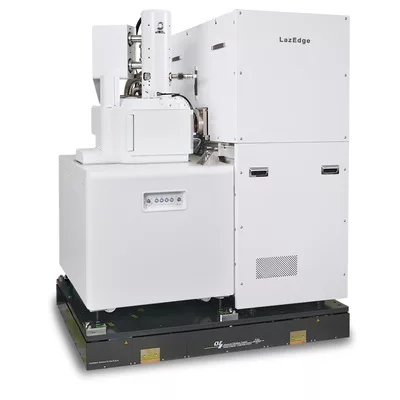
JEOL Ltd., Japan, announced the sales launch of LazEdge, a SEM system equipped with a laser. Cross-section preparation instruments such as focused ion beam systems are widely used in science and technology fields across research institutes, universities, and industries. In recent years, demand is increasing for a system that can process large-areas at high speed while achieving high-quality of the processed surface. LazEdge is an instrument integrating JEOL’s SEM with proprietary Hamamatsu Photonics K.K. laser technology that enables laser processing inside the specimen chamber of the electron microscope.
This system enables high-quality cross-section specimens produced through high-speed, large-area processing to be transferred seamlessly to subsequent analyses, such as SEM observation, elemental analysis, and crystal orientation analysis, without exposure to the external environment. As a result, it meets a wide range of analytical needs, including metal specimen analysis, battery analysis requiring air-isolation, and semiconductor failure analysis requiring high-speed cross-sectioning.
By integrating a laser processing system into the SEM, LazEdge achieves high-quality cross-sectioning of large-areas with reduced LIPSS structures at a high speed in the specimen chamber. A proprietary optical system enables this through spatial phase modulation of the laser beam.
The proprietary shielding technology, LazEdge Shield, minimizes debris generated during processing from scattering, and achieves clean processing without the contamination of detectors, columns, and specimen chamber walls. Moreover, the laser system can simultaneously focus on the specimen processing position and the laser irradiation position on the shield. This technology allows for processing and cleaning of the shield (contamination prevention) at the same time. These technologies provide high-quality cross-sectioning while always maintaining stable power.
By installing a shield inside the SEM specimen chamber and performing the processing within the chamber, it is possible to carry out both processing and observation seamlessly and with high throughput. For example, in EBSD measurements, laser processing alone can produce a cross-section with sufficient quality for EBSD measurement. By automatically repeating the processing and measurement, 3D EBSD acquisition is also possible.
For more information:
JEOL Ltd.
https://www.jeolusa.com