Engineers from the University of Surrey, United Kingdom, and Airbus, Netherlands, have revealed a breakthrough nano-barrier that can protect satellites in low-Earth orbit from ultraviolet radiation and atomic oxygen.
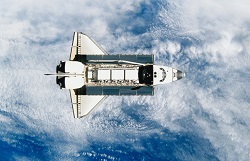
Atomic oxygen is created when O2 molecules break apart, a process made easier in space because of the abundance of ultraviolet radiation. According to NASA, 96 per cent of low-Earth orbit’s atmosphere is atomic oxygen, a reality that caused problems in NASA’s early space shuttle missions.
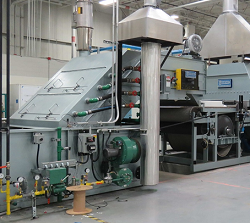
In a paper published by ACS Applied Materials & Interfaces, the team from Surrey’s Advanced Technology Institute and Airbus detail how they developed a nano-barrier and custom-built deposition system that bonds to the surface of polymer or composite materials, protecting them from erosion in low-Earth orbit.
The new cutting-edge nano-barrier allows for large-area, conformal coating on complex 3-D structures such as spacecraft and optical mirrors. This eliminates the risk of contamination and the need to wrap instruments with multi-layer insulation, opening up opportunities to increase satellite performance.
“After exhaustive simulation testing and nearly a decade of collaborative research, we are delighted to reveal the most advanced solution yet to protecting satellites and spacecraft. Our nano-scale coating guards against the damaging effects of UV radiation and atomic oxygen that has plagued space travel,” said Ravi Silva, director of the Advanced Technology Institute at the University of Surrey.
“This breakthrough technology is an enabler for extremely agile, high-performance spaceborne radar missions. It should have a huge positive impact on overall mission performance by offering higher flexibility in the acquisition as well as increasing the possible imaged area – giving our instruments greater performance,” says Christopher Hess, Head of Microwave Instruments at Airbus Space Systems.
The teams from Airbus and Surrey’s Advanced Technology Institute are now working on the next stage leading to industrialization of the coating to enable the first LEO missions to be treated from 2022.
For more information:
Airbus Space Systems
https://www.airbus.com/space.html
University of Surrey
https://www.surrey.ac.uk/news/breakthrough-material-can-protect-satellites-ultraviolet-radiation-and-atomic-oxygen-low-earth-orbit