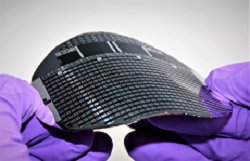
A research team at Fraunhofer ISE, Germany, achieved a record conversion efficiency of 68.9% under monochromatic laser light with a new thin film photovoltaic cell based on gallium arsenide. This is the highest efficiency achieved to date for converting light into electricity.
To achieve this, the researchers used a very thin photovoltaic cell made of gallium arsenide with a highly reflective, conductive mirror on the backside and exposed this III-V semiconductor photovoltaic cell to laser light of 858 nanometers.
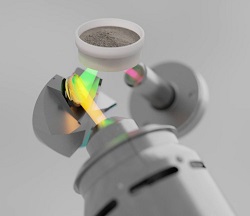
This new form of energy transfer, called power by light, delivers laser energy either through the air or via an optical fiber to a photovoltaic cell whose properties match the power and the wavelength of the monochromatic laser light. Compared to conventional power transmission via copper wires, power by light systems are especially beneficial for applications which require a galvanically isolated power supply, lightning or explosion protection, electromagnetic compatibility, or completely wireless power transmission, for example.
This success was made possible with a special thin film technology in which the solar cell layers are first grown on a gallium arsenide substrate which is then subsequently removed. A conductive, highly reflective mirror is applied to the back surface of the remaining semiconductor structure, which is only a few micrometers thick.
“This thin film approach has two distinct advantages for the efficiency,” explains the physicist Dr. Henning Helmers, head of the Fraunhofer ISE research team. “First of all, photons are trapped in the cell and the absorption is maximized for photon energies close to the band gap, which simultaneously minimizes thermalization and transmission losses, making the cell more efficient. Secondly, the photons additionally generated internally by radiative recombination become trapped and effectively recycled. This extends the effective carrier lifetime, thus additionally increasing the voltage.”
The research group investigated thin film photovoltaic cells with back-surface reflectors made of gold and an optically optimized combination of ceramic and silver, with the latter showing the best results. An n-GaAs/p-AlGaAs heterostructure was developed as absorber, which shows particularly low charge carrier losses due to recombination.
“This is an impressive result that shows the potential of photovoltaics for industrial applications beyond solar power generation,” says a delighted Prof. Andreas Bett, institute director of Fraunhofer ISE.
Image – Courtesy of – Henning Helmer / Fraunhofer ISE.
More information:
Fraunhofer ISE
https://www.ise.fraunhofer.de/en/research-projects/lightbridge.html