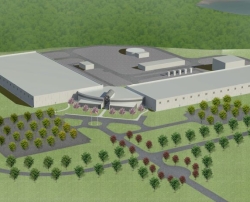
GE Aviation, Cincinnati, has broken ground for two materials factories near Huntsville: One facility will produce SiC ceramic fiber, while the other will use SiC ceramic fiber to make tape for ceramic matrix composite components in jet engines and land-based gas turbines. GE Aviation’s total north Alabama investment will be nearly $200 million. When the plants open, the company will sell fiber to the Department of Defense, GE businesses, Herakles (Safran), and other customers subject to U.S. regulations.
The use of lightweight, heat-resistant CMCs in the hot section of GE jet engines is a breakthrough for the jet propulsion industry. With one-third the density of metal alloys, these ultra-lightweight CMCs reduce the overall engine weight. Further, their high-temperature properties greatly enhance engine performance, durability, and fuel economy. CMCs are far more heat-resistant than metal alloys, hence requiring less cooling air in the engine’s hot section. By using this air instead in the engine flow path, an engine runs more efficiently.
For more than 20 years, scientists at GE’s Global Research Centers and GE’s industrial businesses have worked to develop CMCs for commercial applications. The best-selling LEAP engine, being developed by CFM International, the 50/50 joint company of GE and Safran Aircraft Engines of France, is the first commercial jet engine to use CMCs in the high-pressure turbine section. The LEAP engine, with more than 10,500 orders and commitments, is currently completing certification testing. It is scheduled to enter airline service next year powering the Airbus A320neo and in 2017 powering the Boeing 737 MAX.
GE Aviation is investing more than $200 million to construct two factories on 100 acres in Huntsville, Alabama. When the factories are fully operational later this decade, they are expected to employ up to 300 people. The plants are expected to be completed by the first half of 2018. Production begins in 2018. GE expects to begin hiring the hourly workforce later this year.
“GE Aviation is creating a fully integrated supply chain for producing CMC components in large volume, which is unique to the United States,” said Sanjay Correa, vice president who leads the industrialization of advanced technologies at GE Aviation. “The new factories in Alabama are vital to this strategy. We are deeply gratified by the tremendous local, state, and national support for this effort.”
While meeting critical U.S. needs for CMC materials for commercial and government-funded programs, the new plants will support GE and its international partners in selling and supporting jet engines and gas turbines worldwide. For example, approximately 61% of GE Aviation’s 2015 revenues of $25 billion were derived from customers based outside the United States. GE and its partner companies sell most 70% of its commercial jet engines to non-U.S. companies.