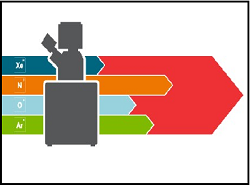
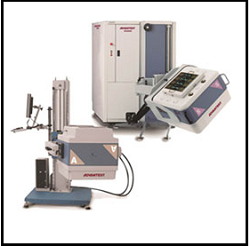
Thermo Scientific, Hillsboro, Oregon, announces that researchers can now apply a range of ion beam species within one focused ion beam scanning electron microscope with the new Helios Hydra DualBeam system. This unique system was designed to deliver four different ions as the primary beam, including argon, nitrogen, oxygen, and xenon. It is easy to switch between them in less than ten minutes without sacrificing performance. This allows researchers and engineers to choose the ion species that provides the best results for their samples, or do fundamental research on the interactions of different ions with matter.
“Integrating the ability for scientists to easily choose between four different ion species within one instrument will expand and optimize the application space for investigating material properties across length scales,” says Mike Shafer, president of materials and structural analysis at Thermo Fisher Scientific. “Our new Helios Hydra DualBeam system provides the flexibility they need to better analyze their samples, improve their results, and develop new and enhanced materials.”
The instrument allows materials science researchers to discover and design new materials and analyze their properties and structure. With its oxygen ion beam, ideally suited for the milling of carbon-based materials such as graphite, it could help researchers develop safer, lighter, and more efficient energy storage devices.
This is the first commercially available instrument of its kind to allow fast and easy ion beam switching. Previously, the application of different beams required researchers to transfer the sample between instruments or conduct lengthy and complicated source exchanges. For example, stand-alone specialized broad-beam argon polishers are currently a typical component of high-quality transmission electron microscopy (TEM) sample preparation workflows. With the Helios Hydra DualBeam instrument, the focused argon beam can be applied to the sample directly after initial milling, vastly reducing transfer and processing time.
With switching times of ten minutes or less, researchers can also apply all four beams to their sample within one session to determine which ion is best suited for the intended purpose. This flexibility expands the potential of FIB in the exploration of ion-sample interactions.