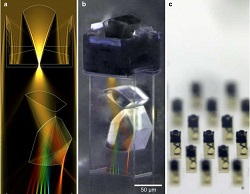
Scientists of the University of Stuttgart, Germany, developed a 3D-printed miniature spectrometer that can be manufactured directly onto camera sensors or arranged for quick (“snapshot”) and low-profile, highly customizable hyperspectral cameras. Miniaturizing spectroscopic measurement devices opens new information channels in medical science and consumer electronics.
Femtosecond direct-laser writing as a 3D printing technology has been one of the key building blocks for miniaturization in recent years. It has transformed the field of complex micro-optics since the early 2000s, currently making it possible to create robust, monolithic and nearly perfectly aligned freeform optical systems on almost arbitrary substrates such as image sensors or optical fibers.
Simultaneously, the miniaturization of spectroscopic measurement devices has been advanced with quantum dot and nanowire technology. These are based on computational approaches, which have the drawback of being calibration-sensitive and require complex reconstruction algorithms.
In a new paper published in Light: Advanced Manufacturing, a team of scientists, led by Professor Alois Herkommer from the Institute of Applied Optics and Professor Giessen from the 4th Physics Institute, University of Stuttgart, Germany, have demonstrated an angle-insensitive 3D printed miniature spectrometer with a direct separated spatial-spectral response.
The design is based on a classical grating spectrometer and was fabricated via two-photon direct laser writing combined with a super-fine inkjet process. Its tailored and chirped high-frequency grating enables strongly dispersive behavior. The miniature spectrometer features a wavelength range in the visible from 490 nm to 690 nm. It has a spectral resolution of 9.2 ± 1.1 nm at 532 nm and 17.8 nm ± 1.7 nm at a wavelength of 633 nm.
Leading author Andrea Toulouse says, “With its volume of less than 100 by 100 by 300 μm3 we explore a whole new size range for direct spectrometers. An order of magnitude this small could only be realized by computational approaches until now. In contrast, we translate the spectrum directly into a spatially encoded intensity signal which can be read out with a commercial monochromatic image sensor.”
“Our spectrometer could be fabricated directly on a miniature image sensor as the tip of a distal chip endoscope. This way, regions in the human body could be examined with extremely high bending radii that were not accessible before” the scientists forecast. “It could also be an interesting approach for hyperspectral imaging where the spectrometer would be used as a unit cell (macro pixel). The redistribution of spectral energy instead of high-loss Fabry-Perot-filtering could thus enable highly efficient hyperspectral imaging sensors. The ever-growing world population could benefit from such a camera if it was used for spectral mapping in precision farming, for instance.”
For 3D printed microoptics, the complexity of the optical design marks an innovation. Refractive, diffractive and spatially filtering elements have never been combined in such a small volume to create a complex and monolithic measurement system.
Image – 3D printed miniature spectrometer. a) wave-optical simulation of the spectrometer. b) microscope image of the fabricated spectrometer overlayed with the intensity distribution from a. c) array of fabricated spectrometers. Courtesy of: Andrea Toulouse, Johannes Drozella, Simon Thiele, Harald Giessen, and Alois Herkommer.
For more information:
University of Stuttgart
https://www.uni-stuttgart.de/en/