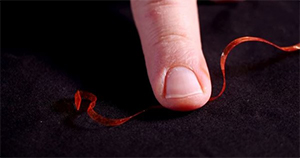
Researchers successfully demonstrated that adding clusters of gold nanoparticles to shape-memory polymers, then stretching them, changes their plasmon-coupling traits, allowing them to have different and beneficial optical properties.
The new material – shape-memory polymers embedded with spherical gold nanoparticles – could be potentially used as a sensor that actuates based on interactions with its optical properties, which can be used to track the thermal history of a target: whether a specific object or the ambient temperature in the environment.
Researchers present their findings in a report titled “Plasmon-Coupled Gold Nanoparticles in Stretched Shape-Memory Polymers for Mechanical/Thermal Sensing,” appearing in the latest ACS Applied Nano Materials.
The basis of this discovery is shape-memory polymers which, when heated, stretched, and allowed to cool down back to room temperature, retain their stretched shape in high temperatures indefinitely. Once reheated to a temperature of 120 degrees Celsius does the polymer material starts to return to its original shape.
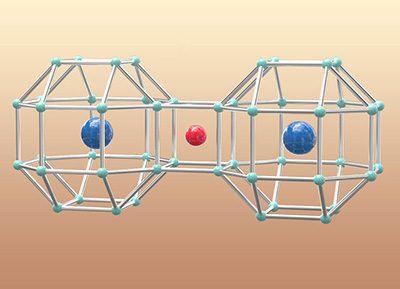
Interestingly, the gold nanoparticles embedded in these shape-memory polymers do not follow a uniform distribution within the material. Instead, these gold materials form clusters that couple their respective surface plasmon resonances. In these plasmon-coupled gold particles, researchers discovered optical properties that vary with the distance of the clusters to each other. These distances, in turn, are affected by how the polymer is stretched and its shape altered.
When researchers stretched the composite sample to about 140 percent beyond its original length, they were able to determine the highest temperature to which the shape-memory polymer is exposed, approaching 120 degrees Celsius, by measuring how much it shrinks back to the original length.
While the idea for the thermal-history sensor was empirically developed, researchers additionally employed computational modeling to better illustrate the behavior of the gold nanoparticles shifted and affected the entire material’s behavior. The spacing between the gold clusters, which determines the strength of plasmon coupling, is called the “plasmon ruler.”
For more information: ACS Publications