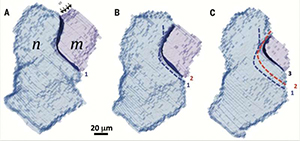
Professors Gregory Rohrer and Robert Suter of Carnegie Mellon University’s Department of Materials Science and Engineering and Department of Physics have uncovered new information that will help materials scientists to predict how the properties of materials change in response to stressors such as elevated temperatures. Using near-field high energy diffraction microscopy (HEDM), they found that the established model for predicting a material’s microstructure and properties does not apply to polycrystalline materials and a new model is needed.
To the eye, most commonly used metals, alloys and ceramics used in industrial and consumer equipment and products appear to be uniformly solid. But at the microscopic level, they are polycrystalline, made up of aggregates of grains that have different sizes, shapes, and crystal orientations. The grains are tied together by a network of grain boundaries that shift when exposed to stressors, changing the material’s properties.
When they make a new material, scientists need to control its microstructure, which includes its grain boundaries. Materials scientists manipulate the density of grain boundaries in order to meet different needs. For example, the structure surrounding the passenger cabin in a car is made of ultrahigh strength steel that contains more grain boundaries than the aesthetic body panels in the car’s front-end crumple zone.
For the last 70 years, researchers have predicted materials’ behavior using a theory that says that the speed at which grain boundaries move throughout a heated material is correlated to the boundary’s shape. Rohrer and Suter have shown that this theory, formulated to describe the most ideal case, does not apply in real polycrystals.
Polycrystals are more complicated than the ideal cases studied in the past. Rohrer explained, “If one considers a single grain boundary in a crystal, it can move without interruption, like a car driving down an empty roadway. In polycrystals each grain boundary is connected to, on average, ten others, so it’s like that car hit traffic — it can’t move so freely anymore. Therefore, this model no longer holds.” On top of that, Rohrer and Suter found that often polycrystal grain boundaries weren’t even moving in the direction that the model would have predicted.
HEDM, a technique that was pioneered by Suter and colleagues using the Argonne National Laboratory’s Advanced Photon Source (APS), was key to these discoveries. HEDM and its associated techniques allow researchers to non-destructively image thousands of crystals and measure their orientations within opaque metals and ceramics. The technique requires high-energy X-rays available only at one of a few synchrotron sources around the world.
For more information: Science