To develop new materials and improve the efficiency of the chemical transformations that will someday provide renewable energy for our homes and businesses, scientists and engineers at Pacific Northwest National Laboratory, Richland, Wash., worked with building architects to design a space within the new Energy Sciences Center that is protected from magnetic fields, vibrations, and temperature fluctuations that can cause distorted images.
In recent years, scientists have discovered that certain arrangements of individual atoms supported on a surface make them special. These distinctive materials confer useful properties. For instance, some single atom catalysts show promise for promoting conversion of biomass and waste carbon at room temperature and at significantly lower costs not possible today. These single atom catalysts are the subject of intense research to figure out how to make them operate on a large scale over a long period of time. And those investigations require studying them, taking atomic-scale “pictures” of them, and correlating their structure to their activity.
“We are searching for metal–oxide supports with a high density of sites that interact strongly with catalytically active metal atoms,” said Zdenek Dohnálek, a PNNL chemist who studies the detailed structure and function of catalysts. “These kinds of catalysts are highly sought after for converting biomass into fuels and commodity chemicals. We are looking at how they evolve, move, and transform on surfaces as a function of temperature and time.”
Answering these basic scientific questions has only become possible within the last few years. It has required the convergence of precision imaging, new sampling, and processing techniques like those that led to Kovarik’s recent microscopy inventions, and the emergence of mathematical methods that can effectively explain what the experimentalists are seeing.
From finding new ways to transform plastic waste into useful products to examining structures at the nanoscale, the research done in this facility will rely on crystal-clear images created in the high-performance instrumentation lab.
The new high-performance instrumentation lab provides four isolated cells doubly protected from any external vibrations by separate vibration-dampening foundations and an inlaid vibration-free table to house delicate instruments, including some of the world’s most vibration-sensitive electron microscopes. Power cords and electronic cabling are housed in a sealed chamber isolated from the instruments, and the temperature in each chamber varies less than 0.1 degree Celsius while the instruments are in use.
The approximately 3000-square-foot space is one of a handful in the world that will be equipped with Themis Z and Spectra Thermo-Fisher 30-300 kV transmission electron microscopes. Each will perch on a specially constructed 9-foot by 9-foot vibration-dampening table within an 18-foot by 22-foot isolated space. The temperature and humidity inside each is constant and controlled to within 0.1 degree Celsius.
“These instruments can acquire atomic-level images at a fraction of the accelerating voltage compared with older models,” said Kovarik. “This is important because the electrons that sample the image can be very damaging and even destroy some samples. When we combine the lower energy required with sampling techniques that allow us to expose less of the sample to electrons, we expand the kinds of materials that we can image successfully.”
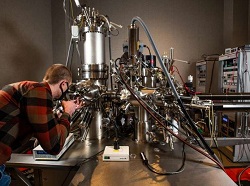
Image – The ultra-high vacuum, low-temperature scanning probe microscope seen here will be moved to the new high-performance instrumentation lab in the Energy Sciences Center in 2022. Courtesy of: Andrea Starr, Pacific Northwest National Laboratory
For more information:
Pacific Northwest National Laboratory