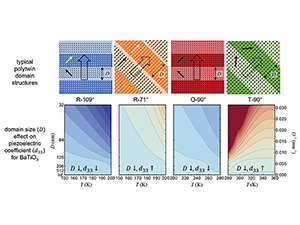
For years, researchers believed that the smaller the domain size in a ferroelectric crystal, the greater the piezoelectric properties of the material. However, recent findings by Penn State researchers have raised questions about this standard rule.
Ferroelectric materials possess spontaneous electric dipole moments that can be reversibly flipped by applying an electric field. Domains are areas in the ferroelectric crystal that have the dipole moments aligned in the same direction. Piezoelectricity is a material property where the crystal generates electrical charge under an applied mechanical force. This capability enables piezoelectrics to be used in electronics, sensors, and actuators.
At a microscopic scale, ferroelectric materials consist of many domains, and these domains range in size from a few nanometers to as much as millimeters. Each domain consists of uniform or nearly uniform distribution of dipole moments, which occur when there is a separation of charge. The regions between adjacent domains are known as domain walls.
The researchers found that the idea that smaller domains lead to higher piezoelectricity is based on very limited existing data without a solid theoretical foundation.
“Based on this conventional wisdom, many in the research community have tried to find ways to make all these domains smaller to enhance the piezoelectricity, and often when they see some improvement in the piezoelectric performance, one of the first things that comes to mind is maybe due to the smaller domains,” said Long-Qing Chen, Hamer Professor of Materials Science and Engineering, professor of engineering science and mechanics, and professor of mathematics at Penn State. “Our work provides a theoretical foundation for correlating the piezoelectricity to crystal symmetry, crystal orientation, and domain configuration.”
In that paper, they referred to findings by other researchers that an AC electric field can improve the piezoelectric response of the crystal by 20% to 40% compared with the crystal treated by a DC electric field. But the team discovered that inside the crystal during AC switching cycles, the domain sizes got bigger, not smaller as would be expected.
“We proposed a theoretical model of domain change under electric fields, we use computation to confirm it, and because of our simulation, we have shown that researchers in the future will have to look inside the crystal,” Chen said.
This new understanding of the relationship between ferroelectric crystal domain size and piezoelectricity can provide guidance to improve piezoelectric performance of materials.
For more information: Penn State University