Sintering refers to joining particles through the combined actions of pressure and heating. The pressed material is heated to below its melting point, and binding between particles occurs due to chemical diffusion between the particles. Further comminution and sieving is necessary to achieve the required particle size distribution. The fabrication of metal shapes from small particles by sintering is a 1000 year old technology. The sintering of metal and ceramics on a large scale is a more recent development that is mainly used for cermets, components made from a combination of metal and ceramics. The Co/WC class of materials are produced by these methods.
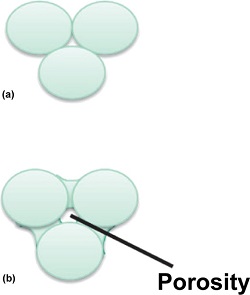
The image indicates that the individual particles become coherently joined in combination with some residual porosity during sintering. Porosity may be reduced by employing higher compaction pressures, higher sintering temperatures, and longer sintering times. However, such changes may be counterproductive in subsequent milling operations, because the strength of the product is greatly increased.
Sintered products normally involve processes that include powder production, shaping of the component from the powder, and strengthening of the powder agglomerate by heat treatment. The production of sintered powders can be considered a scaled-down version for producing engineered components.
Prior to sintering, components are heated to a temperature sufficient to evaporate any volatile components. Sintering is generally based on heating the green component to a temperature above the melting point of at least one of the powder constituents. The process must be completed in a reducing atmosphere or in a vacuum furnace.
It is first necessary to produce the powers of the appropriate chemistry that will be sintered into the desired feedstock. Powder production methods can be classified as either chemical or mechanical processes. The chemical routes include reduction, precipitation, chemical reaction, and electrolysis. The mechanical route includes atomization and disintegration. The reduction method produces powders from oxides of metals with high melting points. The most common reducing media are hydrogen and carbon. The reduced particles sinter together into a spongy mass that is crushed into a powder.
Large quantities of iron powders are produced using the carbon route. A typical precipitation method includes preparation of a carbonyl vapor by passing carbon monoxide at a high temperature over the heated metal. Precipitation of the vapor gives rise to a powder.
Powders are also produced by disintegration of a molten metal by a gas jet or water at high pressure (i.e., atomization). The key methods of producing powder are the atomization process and the reduction process.
Sintered powders exhibit agglomerated morphologies that are not spherical but can be described as being globular with many protuberances on the surface. It may be expected that such a powder is difficult to feed. This is generally true, but the thermal spray parameters for that particular material would be optimized, so these powders are technologically viable. A more important aspect is that the theoretical density of sintered powders is lower than powders obtained from the fused and crushed routes.
Because there is an empirical relationship that relates low densities to low tensile adhesion strengths, then agglomerated powders (or spray-dried and sintered powders) may exhibit lower strengths if their initial low density is reflected in the coating. It is emphasized that such powders are still acceptable for their intended applications and may have the additional benefit of being a lower-cost feedstock material.
The primary advantage of sintering for powder production is that it enhances particle strength so they retain their dimensions during transport to the TS source, as well as during their history within the intense thermal process zone. The sintering process results in some dimensional changes; however, these are not detrimental to the TS feedstock preparation because there will be a subsequent sieving operation.
Image – Sintering of particles.
This information is from ASM Handbooks Online, Vol. 5A: Thermal Spray Technology, Coating Structures, Properties, and Materials. To find this information (subscription required), click on the link below and scroll down to Figure 3.
https://dl.asminternational.org/handbooks/edited-volume/12/chapter/133823/Feedstock-Material-Considerations-for-Thermal