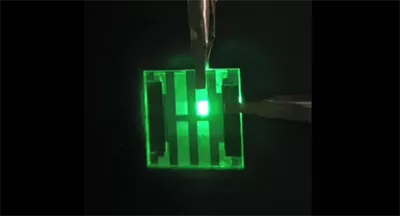
Scientists have created an ultra-thin, paper-like LED that emits a warm, sunlike glow by precisely blending red, yellow-green, and blue quantum dots to mimic natural sunlight. This breakthrough offers improved color accuracy and reduced eye strain, with potential applications in home lighting, electronic displays, and workspaces. Unlike traditional bulky bulbs, this slender design could transform how we light our environments while helping minimize sleep disruption from harsh artificial light.
“This work demonstrates the feasibility of ultra-thin, large-area quantum dot LEDs that closely match the solar spectrum,” says Xianghua Wang, a corresponding author of the study. “These devices could enable next-generation eye-friendly displays, adaptive indoor lighting, and even wavelength-tunable sources for horticulture or well-being applications.”
Many people prefer indoor lighting that feels natural and soothing. Earlier approaches achieved this effect with flexible LEDs that used red and yellow phosphorescent dyes to create a candle-like warmth. A newer alternative relies on quantum dots—tiny semiconductor particles that transform electrical energy into colored light. Some research teams have already used quantum dots to make white LEDs, but replicating the complete spectrum of sunlight has remained difficult, particularly in the yellow and green regions where sunlight is strongest. To address this challenge, Lei Chen and colleagues developed quantum dots that could recreate that balanced, sunlike glow in a thin, white quantum dot LED (QLED). Meanwhile, Wang’s group proposed an efficient conductive material design that could operate effectively at relatively low voltages.
The team began by synthesizing red, yellow-green, and blue quantum dots coated with zinc-sulfur shells. They determined the precise color ratio needed to match the spectrum of natural sunlight as closely as possible. Next, they assembled the QLED on an indium tin oxide glass substrate, layering conductive polymers, the quantum dot blend, metal oxide particles, and finally a top coating of aluminum or silver. The quantum dot layer measured only a few dozen nanometers in thickness—much thinner than standard color conversion layers—resulting in a white QLED with an overall profile comparable to wallpaper.
In initial tests, the thin QLED performed best under a 11.5-volt (V) power supply, giving off the maxmium bright, warm white light. The emitted light had more intensity in red wavelengths and less intensity in blue wavelengths, which is better for sleep and eye health, according to the researchers. Objects illuminated by the QLED should appear close to their true colors, scoring over 92% on the color rendering index.
In further experiments, the researchers made 26 white QLED devices, using the same quantum dots but different electrically conductive materials to optimize the operating voltage. These light sources required only 8 V to reach maximum light output, and about 80% exceeded the target brightness for computer monitors.
For more information: ACS Applied Materials
Image: A paper-thin device uses quantum dots, similar to those described in this work, to light up LEDs. Credit: Lin Zhou, Xianghua Wang