Penn State and Morgan Advanced Materials have signed an MOU to accelerate research and development of silicon carbide (SiC), a semiconductor material that excels at high voltages. This collaborative agreement spans a new five-year, multimillion-dollar initiative. The initiative brings together industry leaders, academic institutions, and government support, aiming to advance SiC crystal research and workforce development.
The agreement also includes a commitment by Morgan to become a founding member of the recently launched Penn State Silicon Carbide Innovation Alliance, as well as to supply the graphite materials and solutions needed for SiC development to Penn State for use by internal and external partners.
The initiative is a coalition of industry leaders, academic institutions and government support led by Joshua Robinson, professor of materials science and engineering and acting associate dean for research in Penn State’s College of Earth and Minerals Sciences.
The MOU outlines how the partners aim to advance carbon research and evaluate how Morgan’s carbon material product impacts SiC wafer fabrication. SiC wafers are a semiconductor material that is increasingly important in the global transition to a greener energy infrastructure and surging demand for semiconductors, as demonstrated by the bipartisan support for the CHIPS for America Act. Traditionally, semiconductor devices have been manufactured from silicon. Silicon carbide is made from tightly arranged silicon and carbon atoms that enable superior performance in a wide range of high-voltage applications, such as high-speed charging stations and power converters in electric vehicles.
Silicon carbide crystals are grown at extreme temperatures — greater than 3,600 degrees Fahrenheit — in a physical vapor transport (PVT) furnace that utilizes a significant amount of carbon to maintain the temperature during the growth process. Similar to insulation in a home, carbon materials made by Morgan act as insulating layers that reduce heat loss and the amount of electricity needed to keep the furnaces running in this weekslong process.
Morgan Advanced Materials is a global company that has been innovating and manufacturing carbon and graphite-based materials essential for growing silicon carbide crystals since the 1990s.
“The new agreement with Penn State seamlessly aligns our goal of establishing Morgan as a key player in the silicon carbide market — we are not only advancing our own graphite competencies but also contributing to the development of high-value products in the market,” said Thomas Connolly, chief technology officer at Morgan Advanced Materials.
A new SiC growth facility in Penn State’s Academic Activities Building at University Park, funded via support from Penn State’s Office for the Senior Vice President for Research and the U.S. Air Force Office of Scientific Research, is expected to be fully operational by the beginning of 2025. This will house a pilot-scale facility that will emulate the entire SiC bulk crystal growth supply chain.
“To have the opportunity to continue our partnership with Morgan Advanced Materials will further solidify the University’s reputation as a leader in silicon carbide research and position us to create bigger and more impactful innovations in the future,” said Clive Randall, director of Penn State’s Material Research Institute.
The Corporate Engagement Center played a key role in expanding Morgan’s commitment to Penn State. The center’s leadership has noted that they anticipate that the alliance will attract additional industry partners.
“Partnerships with public and private entities have allowed Penn State to be the first university in decades to house SiC equipment from boule to wafer processing,” said Andrew Read, senior vice president for research at Penn State. We greatly appreciate Morgan’s continued commitment to Penn State and are looking forward to the discoveries we will make together.”
For more information:
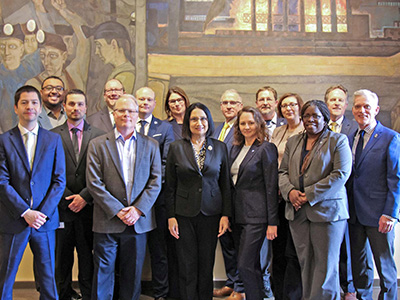
Image: Morgan Advanced Materials visited Penn State recently to sign a memorandum of understanding. From left are: Fernando “Nando” Vallejos-Burgos, Global Testing Labs manager at Morgan Advanced Materials; Michael Wade Smith, senior vice president and chief of staff at Penn State; Joe Abrahamson, lead at Morgan Advanced Materials’ Carbon Center of Excellence; Andy Goshe, director of strategy for Morgan Advanced Materials’ Performance Carbon Division; David Fecko, director of industry collaborations in the Materials Research Institute at Penn State; Thomas Connolly, global technology director and chief technology officer for Morgan Advanced Materials’ Performance Carbon Division; Wendy Pryce Lewis, president of Morgan Advanced Materials’ Performance Carbon Division; Neeli Bendapudi, president of Penn State; Andrew Read, senior vice president for research at Penn State; Ashley Chan, director of corporate engagement at Penn State; Josh Robinson, acting associate dean for research in earth and minerals sciences and director of the Silicon Carbide Crystal Center; Aleksandra Slavkovic, associate dean for research and innovation, Eberly College of Science at Penn State; Tonya Peeples, Harold and Inge Marcus Dean of Engineering and professor of chemical engineering at Penn State; Lee Kump, John Leone Dean of College of Earth and Minerals Science and professor of geosciences at Penn State; and David Lieb, interim vice president development and alumni relations at Penn State