Medical implants have revolutionized healthcare with advanced materials and technologies, but many face challenges like poor cell adhesion, leading to inflammatory responses. Apatite coatings, especially hydroxyapatite (HA) found in bones, can enhance integration with tissues, but artificially synthesized apatite nanoparticles often lack effective binding with biological tissues. Researchers at Nagaoka University of Technology, Japan, have developed surface-modified apatite nanoparticles that improve cell adhesion, paving the way for the next generation of biocompatible medical implants.
Led by Dr. Motohiro Tagaya, Associate Professor at the Department of Materials Science and Bioengineering at Nagaoka University of Technology, Japan, this research aims to enhance the performance of apatite coatings and advance the field of biocompatible materials for medical devices. Along with Dr. Tagaya, Mr. Kazuto Sugimoto from Nagaoka University of Technology, Dr. Tania Guadalupe Peñaflor Galindo from Sophia University, and Mr. Ryota Akutsu from Nagaoka University of Technology were also a part of this research team.
Apatites are a class of calcium-phosphorus-based inorganic compounds, with hydroxyapatite—a naturally occurring form found in bones. These compounds are known for their high biocompatibility. Recent studies have found that coating artificial joints and implants with apatite nanoparticles is a plausible solution for improving the biocompatibility of these biodevices. However, the artificially synthesized nanoparticles often show reduced binding affinity to biological tissues in vitro. According to Dr. Tagaya and his team, this difference could be linked to the nanoscale surface layer of the apatite nanoparticles.
Dr. Tagaya’s research was driven by a desire to unravel the complexities of biocompatible materials, leading his team to develop an interdisciplinary framework that controls the intricate interactions between apatite and biological systems.
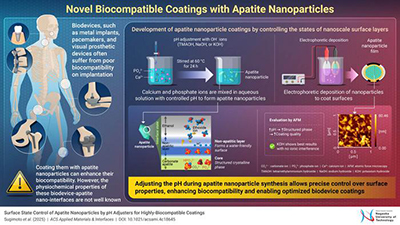
The team synthesized hydroxyapatite nanoparticles by mixing aqueous solutions of calcium and phosphate ions. The pH of the solution was controlled using three different bases, which included tetramethylammonium hydroxide (TMAOH), sodium hydroxide (NaOH), and potassium hydroxide (KOH). The precipitated nanoparticles were then evaluated for their surface layer characteristics and were further used for coating via electrophoretic deposition.
The results revealed that pH was a key factor during synthesis, since it affected the crystalline phases, surface properties, and electrophoretic deposition. On analyzing the crystalline phases of the nanoparticles, it was observed that the choice of pH influenced the formation of different calcium phosphate phases like calcium-deficient hydroxyapatite (CDHA) and carbonate-containing hydroxyapatite (CHA). Higher pH favored the formation of CHA, leading to better crystallinity, and a higher calcium to phosphorus (Ca/P) molar ratio.
The surface of the apatite nanoparticles shows three different layers. The inner apatite layer/core is characterized by the presence of the crystalline structure of the apatite. Above the apatite layer is the non-apatitic layer, which is rich in ions like phosphate ions and carbonate ions. This layer reacts with water molecules and forms the hydration layer. Analyzing the surface characteristics of these layers revealed that pH adjustments facilitated the formation of the non-apatitic layer rich in reactive ions, enhancing hydration properties, which was confirmed.
Importantly, the study revealed that while higher pH facilitates the formation of the non-apatitic layer, the presence of Na+ ions reduces the concentration of phosphate ions, leading to decreased reactivity of the layer. The introduction of substantial ions by NaOH also affected the uniformity of electrophoretic deposition, as observed in scanning probe microscope studies. This effect was not observed with KOH, indicating that KOH was more suitable than NaOH for forming the non-apatitic layer and ensuring uniform coating.
These findings can be potentially useful for surface coating of a wide range of biodevices that are implanted in the human body, including artificial joints and implants.
For more information: ACS Applied Materials & Interfaces
Image: Researchers from Nagaoka University of Technology, Japan develop highly biocompatible apatite nanoparticles by manipulating surface properties through pH changes.