Scientists at the University of California, Irvine, recently expanded on a longstanding model governing the mechanics behind slip banding, a process that produces strain marks in metals under compression, gaining a new understanding of the behavior of advanced materials critical to energy systems, space exploration, and nuclear applications.
Researchers in UC Irvine’s Samueli School of Engineering report the discovery of extended slip bands in a paper published in Nature Communications. Their finding challenges the classic model developed in the 1950s by physicists Charles Frank and Thornton Read.
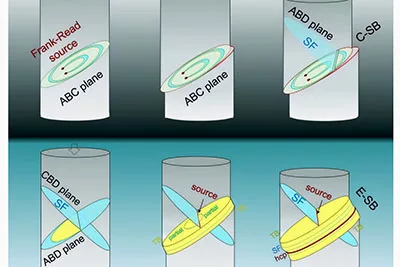
While the Frank–Read theory attributes slip band formation to continuous dislocation multiplication at active sources, the UC Irvine team found that extended slip bands emerge from source deactivation followed by the dynamic activation of new dislocation sources.
The process that results in extended slip bands was observed at the atomic scale by the UC Irvine researchers as they performed mechanical compression on micropillars of an alloy of chromium, cobalt and nickel, recently found to be among the toughest materials on Earth.
Using scanning transmission electron microscopy made possible by the UC Irvine Materials Research Institute and large-scale atomistic modeling, the team was able to view the confined slip band as a thin glide zone with minimal defects and the extended slip band with a high density of planar defects.
“The full dynamics of slip band formation at the fundamental level had not been understood through the more than 70 years since the Frank-Read theory was developed,” said corresponding author Penghui Cao, UC Irvine associate professor of mechanical and aerospace engineering.
“Our ability to capture these processes at atomic and nanometer scales provides new insight into collective dislocation motion and microscopic deformation instability in advanced structural materials. This foundational knowledge will accelerate the discovery of materials with tailored and predictable mechanical properties to meet the rising demand for advanced materials resilient to the extreme environments across energy and aerospace sectors.”
Image – UC Irvine researchers revealed the divergent evolution of slip banding. Top row: formation of a confined slip band (C-SB) from a conventional Frank-Read source with localized glide on slip plane ABC. Bottom row: extended slip band (E-SB) is generated through source deactivation and dynamic activation of new sources. This triggers partial slip and the formation of planar defects such as twin boundaries (TB), stacking faults (SF) and hexagonal close-packed (hcp) regions, resulting in band thickening along the ABD plane. Courtesy of Penghui Cao and Hangman Chen/UC Irvine.
************
For more information:
University of California, Irvine