AMETEK Germany inaugurates new facility in Weiterstadt

Ametek Germany, part of Ametek Inc., inaugurated a new, state-of-the-art Customer Center of Excellence in Weiterstadt, Germany, that will provide enhanced support to its customers through in-person demonstrations of Ametek innovations and solutions across major industries.

The new facility features the latest products from numerous Ametek businesses, including SPECTRO, Taylor Hobson, Solartron Metrology, Creaform, MOCON, Reichert, Atlas, Brookfield, Zygo, Dunkermotoren, EGS, Motec, Powervar, SurgeX, Precitech and TMC. Service capabilities for Ametek products will also be provided.

Ametek Germany started its operations in 1973 in Meerbusch near Düsseldorf and continues to grow. In 2015, it opened the location in Weiterstadt, and since then, increasing customer demand has required an expansion to a larger facility. This new space will serve as an Ametek hub of innovation for numerous industries including aerospace & defense, automotive, food, pharma and packaging, high precision metrology, material analyses, oil and gas, and power.

It held a private grand opening event held in January where Ametek employees were on-hand to provide customers, distributors, and partners with dynamic and interactive technology demonstrations.

“We are thrilled to take this next step in expansion to solve our valued customers’ complex challenges using Ametek’s differentiated technology solutions,” said Wiebke Rumpf, Ametek Germany Country Manager. “This Customer Center of Excellence represents a significant milestone for Ametek’s operations in Germany, and its location near Frankfurt is perfect for customer events, distributor meetings, customer demos and much more.”


For more information:

AMETEK

www.Ametek.com


Powdermet wins the Weatherhead 100 Award

Powdermet, Inc., representing the entire PMT Group of companies, has again been named to the prestigious Weatherhead 100 list of the fastest growing companies in Northeast Ohio.

Established in 1988, the Weatherhead 100 Awards are the premier celebration of Northeast Ohio’s spirit of entrepreneurship and the companies that are leading the way in Northeast Ohio. Each year this program recognizes an elite group of companies that are the best example leadership, growth and success in Northeast Ohio. Companies that make the list earn this distinction based on their growth over the last five years.

Though Powdermet has been named to the Weatherhead 100 multiple times, this year they were recognized as the second-fasted growing organization on the list. Powdermet founder and CEO Andrew Sherman noted, “We’re very proud of this distinction and thankful to all our employees who made it possible. While our subsidiary Terves had an exceptional year, we had great performances from all PMT Group companies. This was an outstanding year and we’re poised for dramatic future growth with significant investment in both facilities and equipment being implemented in 2023.”

PMT group is excited to be part of reshoring and redeveloping critical materials manufacturing in the US. Apart from being the only integrated US wrought magnesium and part producer, PMT group companies are investing aggressively into increased production, rare earth metals, magnets, specialty alloys, and energy storage materials. PMT Group and its subsidiaries Terves, Magnesium USA, Powdermet, Hybrid Materials, Cratus, Magnet Energy and CermeTech are playing an important role in developing and commercializing critical solutions that will enable America to continue to lead and set the path for other nations to follow.


For more information:

PMT Group

https://www.tervesinc.com


Aerobraze OKC awarded USAF contract for F-16 regenerative heat exchanger remanufacture

Aerobraze Engineered Technologies Oklahoma City was awarded a five-year contract with the United States Air Force (USAF) for the remanufacture of F-16 fighter aircraft regenerative heat exchangers at the Tinker Air Force Base. Located in Oklahoma, Tinker Air Force Base is the headquarters of the Air Force Materiel Command’s (AFMC) Oklahoma City Air Logistics Center (OC-ALC), which manages aircraft, engines, missiles and more.

“As a major manufacturer and overhauler of heat exchangers for the USAF for nearly 40 years, it is with great pride that we continue to provide support to the United States Air Force. This new award demonstrates our ongoing commitment to increasing efficiency and cost savings for our customers, through extending the life of critical components for the aerospace industry,” states Brian Martin, director of business development, Aerobraze U.S.

Aerobraze Oklahoma City specializes in the remanufacture/overhaul of F-16 Inconel and aluminum heat exchangers. Assemblies meet the stringent U.S. military requirements including extreme temperatures and complex non-military applications to resist cracking and failure over long-time use. These processes have resulted in efficiency and significant cost savings to maintain and extend the life of F-16 operations for USAF, MROs, and other Foreign Military Services.


For more information:

Aerobraze Oklahoma City

https://metals.wallcolmonoy.com/products-capabilities/aerobraze-oklahoma-city


Plasmatreat presents new plasma nozzles

Plasmatreat GmbH, Germany, the world market leader for atmospheric plasma technology, is launching three new plasma nozzles that expand its large product portfolio to include applications for treating temperature-sensitive materials, the wide-area pretreating of surfaces, and homogeneous surface coating.

Plasma technology can be used to modify the surface properties of a wide variety of materials in order to optimally prepare materials and material combinations for subsequent processes. Plasmatreat has developed various processes for this purpose. In the fine cleaning of metals or glass, for example, with Openair-Plasma, surfaces are gently and safely freed from dust, grease, release agents and additives. This increases the surface energy and optimizes the wettability of the substrate surface.

During activation, the surface of the substrate, e.g. the non-polar plastic, reacts with molecules excited by plasma. In this process, oxygen groups are introduced into the top layer of the plastic, significantly improving adhesion. This makes bonding, painting, printing or gasketing easier, or, in some cases, possible in the first place.

For the environmentally friendly pretreatment, plasma is applied to the substrate with pinpoint accuracy using simple compressed air through a special nozzle.

One of Plasmatreat’s core competencies is the application-specific coordination of distance, treatment width and traversing speed – and the selection of the right nozzles for the process in question. Another process, PlasmaPlus technology, uses nanocoatings to create functionalized surfaces, such as an adhesion promoter layer or an anti-corrosion coating. In this technology, a precursor is added to the plasma jet and a nanolayer with the desired properties is then deposited.

With the RD2005PAD, a rotary nozzle for coating with PlasmaPlus technology is now available for the first time. This process uses nanocoatings to create specifically functionalized surfaces that are tailor-made to meet customer requirements with regard to planar materials. The spectrum ranges from superhydrophobic, adhesion-promoting to superhydrophilic coatings.

With the RD2005PAD, the first rotary nozzle with precursor feed, Plasmatreat is once again the pioneer. Until now, only static nozzles were used worldwide for this coating application, which had its focus in the selective modification of surfaces. The new nozzle, which rotates around a rotation axis, is now suitable for coating flat materials and now also offers the advantage of a particularly homogeneous treatment with high intensity in the PlasmaPlus process. This produces a reliable functional layer that enables optimum bonding, printing or painting of the coated surface.

Plasmatreat has developed another new nozzle, the PFW10LT, a low-temperature nozzle that also activates thermally sensitive materials and surfaces with high intensity. It is designed for use at low temperatures below 60 °C and performs a particularly gentle pretreatment of plastics prior to subsequent processes, e.g. bonding. The plasma nozzle is particularly suitable for small treatment areas and contours such as boreholes or groove areas, for low-lying applications in 3D components or for medical components and products. The PFW10LT plasma nozzle is used for a treatment width of approx. 4 mm.

Plasmatreat’s third new plasma nozzle, the PFW100, is now available to treat flat components or surfaces at high process speeds and at the same time over a large width. It is particularly suitable for the pretreatment of heat-sensitive materials such as thin plastic films or textile products such as synthetic nonwovens. It can also be used for the surface cleaning of glass or metal. The PFW100 performs uniform pretreatment over a width of 100 mm per plasma nozzle at relative speeds of up to 200 m/min. The treatment width can be flexibly varied via the modular arrangement of several nozzles.

In order to treat flat components or surfaces at high process speeds and at the same time over a large width, the PFW100 is now available as a suitable plasma nozzle.


Image – The RD2005PAD is a rotating nozzle for coating of planar materials.


For more information:

Plasmatreat GmbH

https://www.plasmatreat.com/


Jabil strengthens additive manufacturing offerings

Jabil Inc. has launched PK 5000, an eco-friendly, powder-based additive material engineered to deliver improved strength, chemical resistance, and resilience in comparison to general-purpose nylon materials, such as PA 12. This patent-pending material has been formulated to support highly demanding automotive, consumer electronics, defense, medical, and industrial manufacturing applications.

PK 5000 was created, tested, and validated at Jabil’s Materials Innovation Center in Chaska, Minn., where polymer formulations, compound developments, and material system integration are completed from start-to-finish under one roof. Highly experienced additive manufacturing engineers, chemists, materials scientists, and production experts leverage Jabil’s innovations in materials science to oversee each step of the beaker-to-box process of developing customized powders and filaments all under an ISO 9001-2015 quality management system.

This newest material features a unique combination of chemical and mechanical properties, such as high-impact strength, high-abrasion resistance, and improved elongation over other nylon materials to withstand functional testing and use. Equally important, PK 5000 has high-barrier properties and low-moisture absorption, which may be critical for ensuring the quality and resilience of certain parts and products exposed to fuel and water. Moreover, the polyketone resin used to make PK 5000 is an eco-friendly, low-carbon material that is made from carbon monoxide. The ability to leverage carbon monoxide, which is a leading cause of atmospheric pollution, may reduce the overall carbon footprint.

In addition to advancements in materials, Jabil continues to extend its global additive manufacturing platforms and solutions to complement its world-class manufacturing capabilities. Jabil has deployed hundreds of 3D printers – from desktop models to highly sophisticated industrial systems – to address a vast range of prototyping, tooling and volume-scale production demands.

For more information: Jabil Inc.

https://www.jabil.com/

Tokamak Energy and Furukawa Electric Group strengthen relationship to progress commercial fusion energy

Furukawa Electric, Japan, has signed an agreement with Tokamak Energy to supply specialist high temperature superconducting (HTS) wire for its new advanced prototype fusion device, ST80-HTS.


Furukawa Electric Co., LtdTokyo, Japan and SuperPower Inc, New York, USA of Furukawa Electric Group, are expected to deliver more than several hundred kilometers of wire to the Oxford-based company for the next phase of construction. ST80-HTS will be the world’s first high field spherical tokamak using HTS magnets at scale and will utilize HTS wire developed and supplied by Furukawa Electric Group. This is a key stage in the path to Tokamak Energy’s fusion pilot plant which will demonstrate the capability to deliver clean electricity into the grid in the early 2030s, producing up to 200 MW of net electrical power.


HTS magnets are an essential enabler for the low cost, commercial operation and global deployment of spherical tokamak devices. They are essential for confining the fuel, which reaches temperatures above 100 million degrees Celsius. Tokamak Energy and Furukawa Electric Group are respectively leaders in the fields of HTS magnet design and superconducting wire development.


Read further here.

Nupress and SPEE3D partnership brings patented cold spray technology to Australian manufacturers

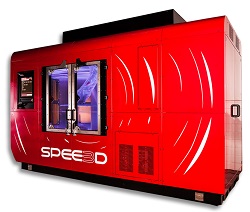
SPEE3D, Australia, announced its WarpSPEE3D printer will be hosted at Nupress headquarters in Australia. Meaning local Australian manufacturers and businesses will be able to access the machine through a subscription without having to lease or purchase it.

This unique subscription model will provide Nupress’s existing clients in the mining, building, aerospace, defense, and medical industries, and other Australian manufacturers’ access to SPEE3D’s patented cold-spray technology. It will provide them the opportunity to source parts locally and quickly from a selection of 12 different metals.

Nupress is a leading manufacturer of precision machined components and assemblies with over 50 years of expertise. Together with SPEE3D, the game-changing subscription service will enable Nupress clients and other Australian manufactures to produce parts at the time of need, rather than waiting weeks or months via other supply chains. Because metal parts can now be sourced locally, this will help manufacturing companies improve their operations and reduce costs – many of which have been impacted negatively due to ongoing global supply chain issues. The subscription model offers one to six slots, each delivering 25 hours per month of printing for 12 months.

“Democratizing access to SPEE3D’s WarpSPEED printer will help solve real-world problems around broken supply chains, manufacturing challenges, and massive delays for some of the world’s most significant industries. Local Australian companies can now access our technology thanks to Nupress, enabling smaller production runs, prototyping needs, material developments, and other advanced manufacturing capabilities,” said Steven Camilleri, Co-Founder, and CTO of SPEE3D.


Image – WarpSPEE3D, the technology that will be available at Nupress on a subscription-based service for local Australian organizations.


For more information:

Nupress

https://www.nupress.com.au/


SPEE3D

https://www.spee3d.com/


Titomic successfully raises $5.1 million

Cold spray additive manufacturing company Titomic, Australia, announced it raised $5.1 million through a share placement, including $2.2 million from its existing strategic investor and joint venture partner Repkon.

Titomic Directors Herbert Koeck and Dag Stromme were also significant investors in the round, it said.

Managing Director Koeck told investors that the new funds would give Titomic “an ability to continue to execute on joint ventures, machine sales, workflow solutions, application development and reseller opportunities.”

He added that Repkon’s “additional strategic investment builds on our strong relationship, with JV and reseller agreements in place, as we move forward with the integration of Titomic’s TKF process and Repkon’s flowforming capabilities for the production and distribution of high-performance barrels in the defense sector.”


Image – Courtesy of Titomic.


For more information:

Repkon

https://www.repkon.com.tr/en


Titomic

https://titomic.com/


Oerlikon invests in its Surface Solutions business with a new state-of-the-art assembly and production site in Switzerland

Oerlikon, Switzerland, a global leader in surface technology, polymer processing, and additive manufacturing, is planning a new state-of-the-art assembly and production site for its surface solutions and equipment businesses. The Group’s current locations in Wohlen, Dottikon and Winterthur will be merged at the Reichhold Campus in the canton of Aargau. With this investment, Oerlikon is affirming its commitment to Switzerland as a business location.

Oerlikon is developing a new, attractive site on the Reichhold Campus in Hausen/Lupfig together with HIAG Immobilien Schweiz AG. This state-of-the-art site will provide customers with Oerlikon Metco thermal spray solutions, including equipment assembling and production services. The new location will enable further improvements in productivity and more optimized operational processes.

The Campus Reichhold site, spread across a total of around 14,500 m2 of production and office space, will also serve as a sales and distribution center for the materials product line, house an IT competence center, and offer around 230 employees an attractive workplace. A strong focus will be placed on sustainability and innovative approaches to future-oriented energy, mobility and utilization concepts.

The application for the building is planned to be submitted in the Summer of 2023. Construction is scheduled to start in the Spring of 2024, and the new location is expected to be ready for moving in from mid-2025 onward. At the current sites, all activities and work will continue as usual. According to the current plan, the move will begin in the summer of 2025 and will take place gradually to ensure the continued processing of all customer orders.


Image – Courtesy of Nau.ch / Wener Rolli and HAIG.


For more information:

HIAG Immobilien Schweiz AG

https://www.hiag.com/


Oerlikon

https://www.oerlikon.com


Augmented reality-enabled cold spray robot from AFRL wins defense tech award

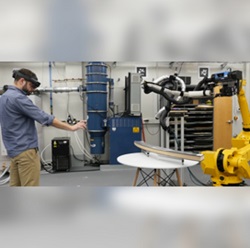
The Air Force Research Laboratory and the Advanced Robotics for Manufacturing Institute won the Defense Manufacturing Technology Achievement Award for leading a development of a cold spray robot used in aerospace equipment refurbishment.

Dubbed ARRI, the augmented reality-enabled cold spray robot was created at AFRL’s Materials and Manufacturing Directorate. ARRI functions with the Microsoft Hololens virtual reality headset, which helps the human user control where a thermal coating should be applied on an aerospace workpiece undergoing rehabilitation.

In addition to funding from the laboratory, cost sharing agreements were signed with members of the ARM Institute as well as project integrators at the University of Connecticut and Titan Robotics to complete the project.

ARRI was installed in July at Warner Robins Air Logistics Complex, Robins Air Force Base in Georgia. WR-ALC invested $1.6 million to obtain two more ARRI-enabled controllers from Titan Robotics.

“The ARRI robot allows someone with no cold spray experience to be trained in about a day. The system also speeds up the time it takes to spray, reduces fixture costs, and improves capacity,” shared Shane Groves, robotics and automation expert at WR-ALC. He noted that the technology reduced training time by 90 percent and can save $600,000 in annual depot operating costs.


Image – Courtesy of: AFRL.


For more information:

Advanced Robotics for Manufacturing Institute

https://arminstitute.org/


AFRL

https://www.afrl.af.mil/


Titan Robotics

https://titan3drobotics.com/


University of Connecticut

https://uconn.edu/


Spray Tips: Mechanical methods for producing thermal spray powders

The purposes of milling are many: to reduce the size of particles or agglomerates, to eliminate particle segregation or preferred orientation in single-phase particles or in multicomponent powder systems, and to homogeneously disperse the many components.

Three basic stages are followed during the milling process: an initial rapid reduction in the size of aggregates, fracture of individual particles, and eventually, reagglomeration of fine particles after extended milling. The initial aggregates may be approximately 10 to 15 μm (0.4 to 0.6 mil), and these will be reduced to fines of the order of 0.1 μm (0.004 mil).

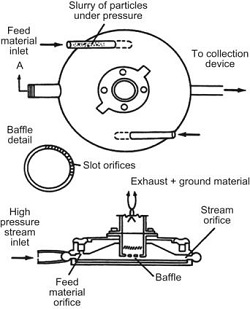
The problems of mill wear have been partially overcome with fluid energy and shear mills. The operating principle of these devices is similar. The material is incorporated into either a gas or a liquid stream, and two streams of the fluidized material are forced to be coincident. The individual particles collide and abrade each other. The grinding efficiency of these mills is high and there is minimum contamination, because there is little high-velocity contact with the walls of the mill. The major problem with this type of mill is the necessity to separate a fine particle from the fluidizing gas or liquid. The required filtering system adds to the complexity of the milling operation.


Image – Fluid energy mill.

This information is from ASM Handbooks Online, Vol. 5A: Thermal Spray Technology, Coating Structures, Properties, and Materials. To find this information (subscription required), click on the link below and scroll down to Figure 2.
https://dl.asminternational.org/handbooks/edited-volume/12/chapter/133823/Feedstock-Material-Considerations-for-Thermal


AI discovers new nanostructures

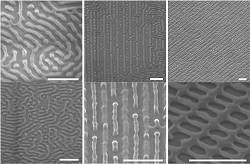
Scientists at the U.S. Department of Energy’s (DOE) Brookhaven National Laboratory, Upton, N.Y., have successfully demonstrated that autonomous methods can discover new materials. The artificial intelligence (AI)-driven technique led to the discovery of three new nanostructures, including a first-of-its-kind nanoscale “ladder.” The research was published in Science Advances.

The newly discovered structures were formed by a process called self-assembly, in which a material’s molecules organize themselves into unique patterns. Scientists at Brookhaven’s Center for Functional Nanomaterials (CFN) are experts at directing the self-assembly process, creating templates for materials to form desirable arrangements for applications in microelectronics, catalysis, and more. Their discovery of the nanoscale ladder and other new structures further widens the scope of self-assembly’s applications.

“Self-assembly can be used as a technique for nanopatterning, which is a driver for advances in microelectronics and computer hardware,” said CFN scientist and co-author Gregory Doerk. “These technologies are always pushing for higher resolution using smaller nanopatterns. You can get really small and tightly controlled features from self-assembling materials, but they do not necessarily obey the kind of rules that we lay out for circuits, for example. By directing self-assembly using a template, we can form patterns that are more useful.”

Staff scientists at CFN, which is a DOE Office of Science User Facility, aim to build a library of self-assembled nanopattern types to broaden their applications. In previous studies, they demonstrated that new types of patterns are made possible by blending two self-assembling materials together.

“The fact that we can now create a ladder structure, which no one has ever dreamed of before, is amazing,” said CFN group leader and co-author Kevin Yager. “Traditional self-assembly can only form relatively simple structures like cylinders, sheets, and spheres. But by blending two materials together and using just the right chemical grating, we’ve found that entirely new structures are possible.”

Blending self-assembling materials together has enabled CFN scientists to uncover unique structures, but it has also created new challenges. With many more parameters to control in the self-assembly process, finding the right combination of parameters to create new and useful structures is a battle against time. To accelerate their research, CFN scientists leveraged a new AI capability: autonomous experimentation.

In collaboration with the Center for Advanced Mathematics for Energy Research Applications (CAMERA) at DOE’s Lawrence Berkeley National Laboratory, Brookhaven scientists at CFN and the National Synchrotron Light Source II (NSLS-II), another DOE Office of Science User Facility at Brookhaven Lab, have been developing an AI framework that can autonomously define and perform all the steps of an experiment. CAMERA’s gpCAM algorithm drives the framework’s autonomous decision-making. The latest research is the team’s first successful demonstration of the algorithm’s ability to discover new materials.

“An old school way of doing material science is to synthesize a sample, measure it, learn from it, and then go back and make a different sample and keep iterating that process,” Yager said. “Instead, we made a sample that has a gradient of every parameter we’re interested in. That single sample is thus a vast collection of many distinct material structures.”

Then, the team brought the sample to NSLS-II, which generates ultrabright x-rays for studying the structure of materials and used the Soft Matter Interfaces (SMI) beamline in this study.

“One of the SMI beamline’s strengths is its ability to focus the x-ray beam on the sample down to microns,” said NSLS-II scientist and co-author Masa Fukuto. “By analyzing how these microbeam x-rays get scattered by the material, we learn about the material’s local structure at the illuminated spot. Measurements at many different spots can then reveal how the local structure varies across the gradient sample. In this work, we let the AI algorithm pick, on the fly, which spot to measure next to maximize the value of each measurement.”

As the sample was measured at the SMI beamline, the algorithm, without human intervention, created of model of the material’s numerous and diverse set of structures. The model updated itself with each subsequent x-ray measurement, making every measurement more insightful and accurate.

In a matter of hours, the algorithm had identified three key areas in the complex sample for the CFN researchers to study more closely. They used the CFN electron microscopy facility to image those key areas in exquisite detail, uncovering the rails and rungs of a nanoscale ladder, among other novel features.

From start to finish, the experiment ran about six hours. The researchers estimate they would have needed about a month to make this discovery using traditional methods.

“Autonomous methods can tremendously accelerate discovery,” Yager said. “It’s essentially ‘tightening’ the usual discovery loop of science, so that we cycle between hypotheses and measurements more quickly. Beyond just speed, however, autonomous methods increase the scope of what we can study, meaning we can tackle more challenging science problems.”

“Moving forward, we want to investigate the complex interplay among multiple parameters. We conducted simulations using the CFN computer cluster that verified our experimental results, but they also suggested how other parameters, such as film thickness, can also play an important role,” Doerk said.

The team is actively applying their autonomous research method to even more challenging material discovery problems in self-assembly, as well as other classes of materials. Autonomous discovery methods are adaptable and can be applied to nearly any research problem. “We are now deploying these methods to the broad community of users who come to CFN and NSLS-II to conduct experiments,” Yager said. “Anyone can work with us to accelerate the exploration of their materials research. We foresee this empowering a host of new discoveries in the coming years, including in national priority areas like clean energy and microelectronics.”

Image – Scanning-electron microscopy images depict novel nanostructures discovered by artificial intelligence. Researchers describe the patterns as skew (left), alternating lines (center), and ladder (right). Scale bars are 200 nanometers.


For more information:

Brookhaven National Laboratories

https://www.bnl.gov

Graphene nano-mechanical-switches could make our electronics even smaller and ultra-low-power

The quest for an ideal switching device for ultra-low power applications leads to an exploration of novel micro/nanoelectromechanical systems (M/NEMS) switches. This research has been driven by the superior performance of M/NEMS devices, such as ideally abrupt switching with zero off-state leakage, suitable for harsh and extreme environments, and very small footprints.

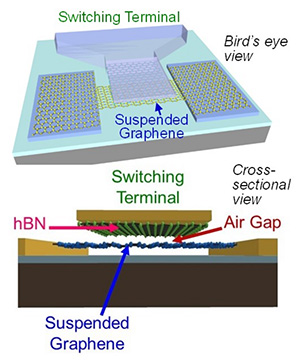
The suspended element of the NEMS switch is electro-mechanically moved by the applied electric field to establish physical contact with the counterpart of the switch, and thereby the conducting channel is established. However, an unacceptably high switching voltage of NEMS switches is the main obstacle to their practical use of it in low-power integrated circuits. In particular, sub-0.5 V switching voltage with a very small switch footprint, which is needed for ultra-low power circuits, has not yet been proven because of irreversible switching failure caused by surface adhesion. Moreover, once physical contact is created in NEMS switches, the switch contact area is increased, which leads to the domination of the surface attraction force over the mechanical restoring force; and as a result, permanent adhesion occurs.

To succeed in realizing NEMS switch for ultra-low power applications, the thickness of movable suspended material thickness has to be reduced as well as the switch contact adhesion in the ON state has to be overcome to reach the OFF state. The research team led by Dr. Manoharan Muruganathan (Former Senior Lecturer), and Professor Hiroshi Mizuta at the Japan Advanced Institute of Science and Technology (JAIST) proposed graphene-based NEMS switch research for this purpose.

In the NEMS switch, the switching voltage is directly proportional to the suspended beam thickness, while the graphene monolayer is the thinnest material in the world today. Also, graphene shows cubic mechanical restoring force in the ON state, which is crucial to avoid stiction. Due to this unique characteristic, this research team pursued the graphene NEMS switch based on the doubly clamped suspended graphene beam with the hexagonal boron nitride (hBN) contact at the switching terminal.

Graphene-to-hBN binding strength is low due to its van der Waals (vdW) bonding nature, which will overcome the stiction issue of NEMS switches says the researcher Dr. Ngoc Huynh Van of Technical University of Denmark.  Based on the unique choice of materials and NEMS switch design, they have demonstrated sub-0.5 V switching characteristics with more than 50,000 hot-switching cycles of operation. Moreover, these NEMS switches show excellent switching characteristics, such as ~5 mV/dec switching slope, nearly-zero hysteresis, and >105 ON/OFF ratio, which meets the mainstream CMOS technology requirements.

These NEMS switches will play a vital role in various NEMS devices, sensors, NEM-CMOS hybrid integrated circuits, and ultralow-power applications.

For more information: Advanced Functional Materials

One Minute Mentor: Fluidized-Bed Furnace

A fluid bed results when a gas is passed upward through a bed of small solid particles at a rate fast enough to lift these particles and to create turbulence. This motion of particles, which are usually made of aluminum oxide or silica oxide, is similar to that of a fluid.

Continue reading

Bodycote to offer new services in the Middle East

Bodycote, the world’s largest provider of heat treatment and specialist thermal processing services, is expanding its thermal spray coatings capability in the Middle East. Bodycote has entered into a partnership with Mathevon Group to develop the market in the region and, in particular, Saudi Arabia

Continue reading

Spray Tips: Manipulation variables

For continuous and even deposition of the coating, Controlled relative movement of the gun with respect to the part and other parameters such as standoff distance, surface speed, angle of impingement, and pitch or increment are critical.

Continue reading