
Oerlikon Metco, Switzerland, is revolutionizing thermal spray equipment with digitalization and the implementation of Metco IIoT, the first Industry 4.0 platform for the thermal spray industry.
Continue reading

Oerlikon Metco, Switzerland, is revolutionizing thermal spray equipment with digitalization and the implementation of Metco IIoT, the first Industry 4.0 platform for the thermal spray industry.
Continue reading
Castolin Eutectic, Belgium, introduced XupersoniClad in the European market, a new thermal spraying service leveraging supersonic spraying technology with significant advantages in the protection of components, vessels, and structures from abrasion, erosion, and wear.
Continue reading
Scientists at the U. S. Department of Energy’s Oak Ridge National Laboratory, Oak Ridge, Tenn., invented a coating that could dramatically reduce friction in common load-bearing systems with moving parts, reducing the friction of steel rubbing on steel at least a hundredfold.
Continue reading
Powders produced by way of the sol-gel route. The sol structure can be in either an aggregated or dispersed structure, so varying degrees or particle alignments are obtained when the conversion to a gel takes place.
Continue reading
Kymera International, Research Triangle Park, N.C., a global leading specialty materials company, announced that it has closed its transaction with Thermal Spray Solutions, Inc., acquiring substantially all their assets.
Continue reading
Oerlikon Balzers, Switzerland, a world-leading technology brand of Oerlikon for thin-film coatings, has won the Magna Supplier Innovation Award 2022 in the “Transmission Solutions” category with its Smart Coatings.
Continue reading
The new ArcX facility in Houston Texas, from Höganäs, Sweden, inaugurated in March 2023, is set to further strengthen the company’s position in the surface coating market and will provide state-of-the-art technical support to its surface coating customers.
Continue reading
Titomic Limited, Australia, has received a purchase order from Boeing Space, Intelligence, and Weapons Systems for AUD 132,174 to continue flight qualifications of Titomic Kinetic Fusion manufactured components initiated in 2021.
Continue reading
Researchers at Sandia National Laboratories, Albuquerque, N.M., tested a variety of nickel mixtures as protective coatings to shield stainless steel from the corrosive threats posed by sea air.
Continue reading
There are five steps or stages to produce a powder by way of the sol-gel route.
Continue readingFollowing years of rigorous testing and evaluation, a cold spray metallization technology that was initially demonstrated at the U.S. Navy’s Fleet Readiness Center East is now being fielded on the H-1 line at the depot’s detachment on board Marine Corps Air Station New River.
Continue readingArgonne National Laboratory scientists help start-up company Phase3D advance clean energy and new tech ideas with 3D printing.
Continue readingFisher Barton, Waukesha, Wis., has selected MSI General Corporation for the design and construction of its new industrial building and site development for Accurate Specialties’ Turning Center of Excellence.
Continue readingEngineered Performance Coatings, UK, and Flame Spray Technologies, Netherlands, join forces and form Surface Technology Services (STS), a total solution group active in Thermal Spray Technologies.
Continue readingSol-gel processing, a chemical engineering technique to manufacture ceramic powders successful in the preparation of bulk metal oxides, has been applied for nanoparticle synthesis.
Continue readingKennametal Inc., Pittsburgh, Pa., added the Blast Ninja to its leading portfolio of abrasive blast nozzles for advanced surface preparation delivering improved productivity and enhanced hearing protection.
Continue reading
Two University of Arizona engineers are using a new suite of equipment to develop alloys optimized to undergo both 3D printing and hypersonic flight.
Continue reading
The university recently was awarded three separate contracts totaling $8 million from the Vicksburg-based U.S. Army Engineer Research and Development Center with a focus on data analytics and visualization systems, additive manufacturing and artificial intelligence-driven predictive maintenance.
Continue readingA team of researchers at the University of Manchester has developed a new material called StarCrete, which is twice as strong as regular concrete and made from a mixture of extra-terrestrial dust, potato starch, and salt.
Continue reading SJVN, India, was awarded the CBIP Award for Best Performing Utility in the Hydro Power Sector. The Award will be presented by the Union Minister of Power and New & Renewable Energy, Sh. R.K Singh in March 2023 in New Delhi.
Sh. Nand Lal Sharma, chairman and managing director of SJVN, said the award is a recognition for SJVN’s outstanding contribution towards nation building by successfully executing and operating the mega hydro power stations Nathpa Jhakri Hydro Power Station (1500 MW) and Rampur Hydro Power Station (412 MW) in Himachal Pradesh. Rampur HPS is being successfully operated in Tandem with India’s largest hydro power station NJHPS.
He said as a result of meticulously followed annual plant maintenance schedule using the latest technology, both the power stations have generated more than 9000 million units during the last three years against the combined design energy of 8490 million units while maintaining plant availability factor at more than 105% during this period.
SJVN is also undertaking High Velocity Oxy Fuel (HVOF) hard coating of various underwater project components at State-of-Art in situ Hard Coating Facility established at NJHPS. This is a unique initiative that has been implemented for the first time in India by SJVN.
For more information:
SJVN
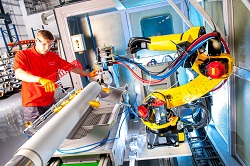 Leading anilox manufacturer Sandon Global (‘Sandon’) continues its program of investments with the installation of two new plasma coating booths at its UK headquarters.
The new booths will use proprietary thermal spray technology to produce anilox coatings that achieve increased hardness and lower porosity ratings than competing products, enabling printers to achieve premium quality print performance, reduce waste and minimize costs.
This new facility marks the latest in a range of investments by Sandon since the company moved to its new purpose-built premises. The site incorporates an in-house state-of-the-art metallurgical laboratory for research and development, enabling the company to further improve the quality of existing coatings and explore new developments.
Last year, the company invested in a powder manufacturing line to develop its own powder coating formulations that are tested using the latest generation equipment to maximize anilox performance. The new plasma coating investment now provides six meter capability to the business enabling it to tap into truly wide-web tissue, toilet roll, non-wovens, corrugated and textiles markets.
Richard Millington, Managing Director of Sandon Global, said: “At Sandon, we are investing in the future of anilox. We never stand still and have made significant progress since the move to our new headquarters with our unique R&D facilities. We’re focused on delivering next generation anilox solutions for a wide range of customers around the world and these latest capabilities change the game for us in terms of product performance and market access. We’re really excited about the progress we can now make in untapped markets.”
For more information:
Sandon Global
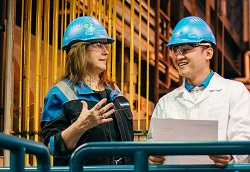 H.C. Starck Tungsten Powders, Germany, is bringing together the research and development activities within the Masan High-Tech Materials Group in an integrated structure. This will create an international innovation hub with a total of almost 40 highly specialized employees at the headquarters in Goslar and at Masan Tungsten LLC in Thai Nguyen, Vietnam.
The combined team focuses on application research in pyro- and hydrometallurgy, the optimization of existing processes and products, and the development of new, disruptive solutions and technologies.
The combined resources and capabilities are intended to make the company’s innovation processes even more powerful, flexible and effective. To achieve this, further investments in laboratory equipment and qualification measures are planned, especially at the Masan Tungsten LLC, APT Factory in Thai Nguyen.
Image – Julia Meese-Marktscheffel, Director Technology and Innovation Global at H.C. Starck Tungsten Powders, with Dai Ngyuen Van, R&D Manager at Masan High-Tech Materials’ Thai Nguyen site.
For more information:
H.C. Starck Tungsten Powders
 Electrolytic methods of forming metals that can be electrodeposited are versatile, and it is possible to produce powders of approximately 60 metals. The majority are obtained by molten-salt electrolysis, and powders of approximately 20 metals can be electrodeposited from aqueous solutions. While a larger number of metals can be obtained in powder form by way of molten-salt electrolysis, the larger quantities of powders are produced by electrolysis from aqueous solutions. Powders such as copper, iron, and nickel are obtained from aqueous solutions.
Electrodeposited metal powders are of high purity and therefore are extremely active during sintering. However, they demonstrate the following deficiencies: the process demands purification so that residual impurities could be removed, the electrolysis technique is often expensive, and the process is usually limited to the production of pure metal (i.e., nonalloyed) powders.
Electrolytic metal powder forms as a dendritic electrodeposit, which can spontaneously fall off or can be removed from the electrode by tapping or by other similar ways. The powder has a tendency to form flakes or needles, or be deposited in fibrous or spongy forms, depending on the electrodeposition process parameters and on the nature of the metal.
Electrolysis conditions that favor the diffusion process of electrodeposition enhance the formation of electrolytic metal powder. For example, a decrease of metal salt concentration, an increase in concentration of an electrolyte, a decrease of stirring rate, an increase of current density, a decrease of temperature, and an increase of the solution viscosity are factors favoring powder formation. In addition to these factors, the deposit structure depends on the nature of the metal and the salt species used in the electrolyte solution.
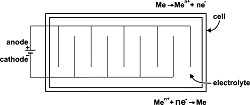
The scheme of an electrolytic cell for electrodeposition of metal powder is shown in the image. It is similar to a cell that is used for electroplating. The cell must have a slanting bottom so that the powder can be guided to a collection place for removal.
Image – Electrolytic cell for the deposition of metal powder.
This information is from ASM Handbooks Online, Vol. 5A: Thermal Spray Technology, Coating Structures, Properties, and Materials. To find this information (subscription required), click on the link below and scroll down to Figure 4.
 Höganäs, Sweden, is opening a new ArcX facility in Houston Texas to further strengthen the company’s position in the surface coating market and provide state-of-the-art technical support to its surface coating customers.
The 12,000 square foot facility will be located close to many big OEMs in various industries and will set global coating technology trends for the future. It will offer customer support, application development, technical solutions, as well as training, complimenting and building upon the other global ArcX centers within the Höganäs organization.
“Our new ArcX facility in the US is an important strategic move for Höganäs. Particularly in North America with many OEMs as driving forces to develop technological breakthroughs. This expansion is part of our company’s continued commitment to serving our customers in the Americas, helping us become a trusted technical partner for our customers and work together to create future opportunities,” says Hans Keller, President Surface & Joining Technologies.
Höganäs’ experts, who specialize in materials, processes, and customer applications, will make ArcX North America a unique development partner with full end-to-end knowledge; from concept development, prototyping, and process optimization to taking the products to the market. It will provide customers with the right material for the right application and the right process.
Selected capabilities:
Application development in laser, PTA and thermal spray
Process optimization for laser, PTA and thermal spray applications
For more information:
Höganäs
Lindberg/MPH, has announced the shipment of an electrically heated, steam atmosphere pit furnace for steam treating parts. Manufacturers use the steam treating process to create a uniform blue-black finish on the surface of parts which improves wear and corrosion resistance.
Continue readingThe indirectly heated fluidized-bed furnace is heated electrically though a fluidized-bed furnace may also be gas heated. Fluidized beds have been designed to perform a wide variety of heat treating tasks including stress relieving, preheating, hardening, quenching, annealing, and tempering, as well as a variety of surface treatments such as carburizing, nitriding, and steam tempering.
Continue readingSolar Atmospheres, Hermitage PA, has announced the approval of a critical Boeing specification for the oil quenching of alloy steels in accordance with Boeing’s specification BAC 5617.
Continue readingNitrex Vacuum, Quebec, Canada, has supplied a new vacuum furnace to the Korea Institute of Materials Science (KIMS) to enhance its vacuum heat-treating capabilities. The investment in the new furnace aims to support KIMS’ wide range of technological R&D activities.
Continue reading
Solar Atmospheres of Wstern Pennsylvania, Hermitage, has had a hand in heat treating several critical parts for NASA’s unmanned Orion spacecraft that launched successfully from Cape Canaveral for a six-week test flight around the moon and back.
Continue reading
Sintering refers to joining particles through the combined actions of pressure and heating. The pressed material is heated to below its melting point, and binding between particles occurs due to chemical diffusion between the particles. Further comminution and sieving is necessary to achieve the required particle size distribution. The fabrication of metal shapes from small particles by sintering is a 1000 year old technology. The sintering of metal and ceramics on a large scale is a more recent development that is mainly used for cermets, components made from a combination of metal and ceramics. The Co/WC class of materials are produced by these methods.
The image indicates that the individual particles become coherently joined in combination with some residual porosity during sintering. Porosity may be reduced by employing higher compaction pressures, higher sintering temperatures, and longer sintering times. However, such changes may be counterproductive in subsequent milling operations, because the strength of the product is greatly increased.
Sintered products normally involve processes that include powder production, shaping of the component from the powder, and strengthening of the powder agglomerate by heat treatment. The production of sintered powders can be considered a scaled-down version for producing engineered components.
Prior to sintering, components are heated to a temperature sufficient to evaporate any volatile components. Sintering is generally based on heating the green component to a temperature above the melting point of at least one of the powder constituents. The process must be completed in a reducing atmosphere or in a vacuum furnace.
It is first necessary to produce the powers of the appropriate chemistry that will be sintered into the desired feedstock. Powder production methods can be classified as either chemical or mechanical processes. The chemical routes include reduction, precipitation, chemical reaction, and electrolysis. The mechanical route includes atomization and disintegration. The reduction method produces powders from oxides of metals with high melting points. The most common reducing media are hydrogen and carbon. The reduced particles sinter together into a spongy mass that is crushed into a powder.
Large quantities of iron powders are produced using the carbon route. A typical precipitation method includes preparation of a carbonyl vapor by passing carbon monoxide at a high temperature over the heated metal. Precipitation of the vapor gives rise to a powder.
Powders are also produced by disintegration of a molten metal by a gas jet or water at high pressure (i.e., atomization). The key methods of producing powder are the atomization process and the reduction process.
Sintered powders exhibit agglomerated morphologies that are not spherical but can be described as being globular with many protuberances on the surface. It may be expected that such a powder is difficult to feed. This is generally true, but the thermal spray parameters for that particular material would be optimized, so these powders are technologically viable. A more important aspect is that the theoretical density of sintered powders is lower than powders obtained from the fused and crushed routes.
Because there is an empirical relationship that relates low densities to low tensile adhesion strengths, then agglomerated powders (or spray-dried and sintered powders) may exhibit lower strengths if their initial low density is reflected in the coating. It is emphasized that such powders are still acceptable for their intended applications and may have the additional benefit of being a lower-cost feedstock material.
The primary advantage of sintering for powder production is that it enhances particle strength so they retain their dimensions during transport to the TS source, as well as during their history within the intense thermal process zone. The sintering process results in some dimensional changes; however, these are not detrimental to the TS feedstock preparation because there will be a subsequent sieving operation.
Image – Sintering of particles.
This information is from ASM Handbooks Online, Vol. 5A: Thermal Spray Technology, Coating Structures, Properties, and Materials. To find this information (subscription required), click on the link below and scroll down to Figure 3.
https://dl.asminternational.org/handbooks/edited-volume/12/chapter/133823/Feedstock-Material-Considerations-for-Thermal