Scientists use high-tech methods to control light in the laboratory, and now, thanks to a new breakthrough that uses a specialized material only three atoms thick, they can control light more precisely than ever before.
The work was conducted in the lab of Harry Atwater, the Otis Booth Leadership Chair of the Division of Engineering and Applied Science, Howard Hughes Professor of Applied Physics and Materials Science, and director of the Liquid Sunlight Alliance (LiSA) at the California Institute of Technology.
Atwater and his co-authors describe how they used three layers of phosphorous atoms to create a material for polarizing light that is tunable, precise, and extremely thin.
The material is constructed from so-called black phosphorous, which is similar in many ways to graphite, or graphene, forms of carbon that consist of single-atom-thick layers. But whereas the layers of graphene are perfectly flat, black phosphorous’s layers are ribbed, like the texture of a pair of corduroy pants or corrugated cardboard.
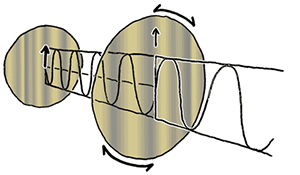
That crystal structure, Atwater says, makes the black phosphorus have significantly anisotropic optical properties. “Anisotropy means is that it’s angle dependent,” he explains. “In a material like graphene, light is absorbed and reflected equally no matter the angle at which it’s polarized. Black phosphorus is very different in the sense that if the polarization of light is aligned along the corrugations, it has a very different response than if it’s aligned perpendicular to the corrugations.”
When polarized light is oriented across the corrugations in black phosphorous, it interacts with the material differently than when it is oriented along the corrugations—kind of like how it is easier to rub your hand along the ribs in corduroy than it is to rub your hand across them.
Many materials can polarize light, though, and that ability alone is not especially useful. What makes black phosphorous special, Atwater says, is that it is also a semiconductor, a material that conducts electricity better than an insulator, like glass, but not as well as a metal like copper. The silicon in microchips is an example of a semiconductor. And just as how tiny structures built from silicon can control the flow of electricity in a microchip, structures built from black phosphorous can control the polarization of light as an electric signal is applied to them.
The liquid crystal display (LCD) technology found in phone screens and TVs already has some of those abilities, but black phosphorous tech has the potential to leap far ahead of it. The “pixels” of a black phosphorous array could be 20 times smaller than those in LCDs, yet respond to inputs a million times faster.
For more information: California Institute of Technology