A team of scientists has proposed a new type of metamaterial that could create backward waves when transmitting sound. They published their design in the journal Nature Communications in June 2021. The team behind the new addition to the metamaterial portfolio was inspired by superfluid helium-4, a liquid form of helium with no viscosity that can only be observed at an extremely low temperature of around minus 450 degrees F. In addition to having the ability to climb up a wall, superfluid helium-4 also exhibits the acoustic backward-wave phenomenon.
However, the researchers’ goal wasn’t to copy superfluid helium-4, said Martin Wegener, a metamaterials researcher at Karlsruhe Institute of Technology in Germany and the senior author of the paper. Instead, he and his team wanted to design a new material from scratch. The team first imagined a simple one-dimensional model with dots and springs, standing in for atoms and bonds. In the model, neighboring dots were connected to each other via springs, forming a row. Since the scientists had deduced from their previous research that the key to backward-wave behavior lies in faraway interactions, the team also added stiffer springs that would connect third-nearest dots. When the team ran mathematical simulations using their model, it exhibited the behavior that the team was looking for: backward waves.
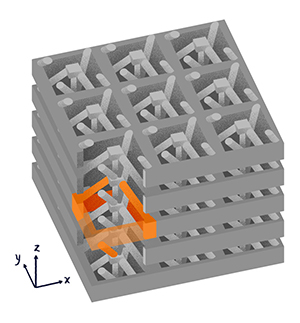
To fabricate a real-life metamaterial, however, the team would have to transform their one-dimensional model into a 3D design — a difficult task, Wegener said. The researchers substituted dots with cubes and springs with bars, and designed a lattice structure where the neighboring cubes are connected vertically, while the third-nearest neighboring cubes are connected via diagonal and horizontal bars. According to the team’s calculations, if the design were to be 3D-printed with precision, the resulting metamaterial would show the ripple of the sound wave moving in the opposite direction of the energy flow.
Alù said Wegener’s and his team’s design exhibited a counterintuitive geometry that scientists wouldn’t immediately think of experimenting with. Typically, when atoms or molecules interact with each other in a material that has a repeating pattern, as in Wegener’s new design, they interact mostly through their nearest neighbors.
Though this metamaterial was developed without a specific application in mind, metamaterial research is typically driven by unmet needs that traditional materials cannot satisfy, the science of making materials with seemingly impossible properties may also lead to discoveries and applications that have yet to be envisioned,
For more information: Nature Communications