In the past, atmospheric furnaces were used quite often for heat treatment of tool steels. Due to the improved furnace technology of vacuum furnaces and their increased distribution in the market, the percentage of tools heat treated in atmospheric furnaces has fallen significantly over the last 20 to 30 years. Furthermore, most of the atmospheric furnaces show a maximum temperature of 1100 °C (2000 °F). Therefore, the application of atmospheric furnaces is limited, with the maximum hardening temperature of the tool steel at or below 1050 °C (1925 °F).
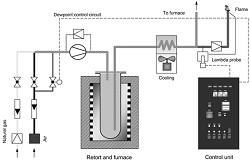
Atmospheric furnaces are often processed with endothermic-based atmospheres, allowing a good protection of tool steel during heat treatment. The endothermic gas generator consists of a retort, which is filled with a catalyst and heated to a constant temperature of 950 to 1050 °C (1740 to 1920 °F); see figure. The retort is fed with natural gas and air, which reacts at the catalytic surface, forming a mixture of approximately 40% H2, 20% CO, and 40% N2, with small traces of residual CH4 (∼ 0.1%), CO2, and H2O.
For more information, click on the link below (subscription required). Then scroll to Figure 3.
R. Schneider ; R. Mesquita ; H. Altena ; T. Müller ; P. Seemann,Processes and Furnace Equipment for Heat Treating of Tool Steels, ASM International, 2014, https://doi.org/10.31399/asm.hb.v04d.a0005958